


MiDFUN Product Module / BKM
Best-known-method and factory knowledge management
BKM captures standard work, improvement knowledge, lessons learned, and reusable factory methods so experience does not stay locked in individual teams.
Best Fit
- Standard work and best-practice reuse
- Factory knowledge retention
- Lessons learned from quality events
Key Capabilities
- Structured knowledge records and review flow
- Searchable standards and reusable methods
- Knowledge links to corrective action and training
QRP Data Flow
BKM preserves the learning produced by 8D, audits, process changes, and production experience for future reuse.
Product Video
Watch the MiDFUN product introduction video for a quick overview of this module and its use cases.
BKM PLUS Enterprise Knowledge & Experience Management System
Bank of Knowledge Management PLUS We have combined APQP Advanced Product Quality Planning and the PPAP Production Part Approval Process with FMEA Failure Mode and Effects Analysis, the CP Control Plan, DCC Document Management, and MEET Meeting & Task Tracking—the in-plant system tools required for knowledge transfer—and, through refined and seamless information linkage between modules, built a Bank of Knowledge Management platform that fits the operations of every plant-wide department, including R&D, quality assurance, production, and management.
APQP Advanced Product Quality Planning · PPAP Production Part Approval Process Management
APQP is an important qualification step that determines whether automotive manufacturers and related industries can place orders with a given plant. To prove that an enterprise and its plant have the capability to take on this new product development, the following systematic requirements must be met. Read more
CP Control Plan
The Control Plan is the key to putting PFMEA and SPC into practice. Regularly reviewing and updating the CP is an important indicator of how thoroughly an enterprise and its plant implement quality control.Quality Control Plan:
This is a control system for planning the key functional characteristics of a product during the mass-production stage. It must be revised in line with customer requirements and with design and engineering changes to the PFMEA, so that it reflects and stays in control of process variations and changes to control items at all times. Beyond sharing most of the same functions as the FMEA module, this module can also notify and update its revision at the same time the FMEA is revised.
The Control Plan further adds planned count control and nonconforming items, and can integrate with the SPC CP module, faithfully playing the pivotal role of carrying forward what came before and inspiring what follows.
FMEA Failure Mode and Effects Analysis
When an item loses its originally intended function, the result is customer dissatisfaction, and a defective product also drives up service costs. FMEA performs a structured analysis of the “failure,” identifies the corresponding failure modes, determines the failure causes, and studies appropriate preventive devices or quality control methods, so that proper planning is in place at the early design stage. Repeatedly performing failure analysis to uncover the latent weaknesses of components or systems—and providing them to the design, manufacturing, and quality assurance units to take feasible countermeasures—will be an extremely valuable knowledge treasure. Read more
DCC Document & Knowledge Center Management Module
Document management is the knowledge base where an enterprise accumulates and applies its know-how. Beyond the benefits of digitalization, an effective electronic document management system—through systematic classification and the construction of a document-control operating mechanism—can effectively capture corporate intelligence and accumulate competitiveness.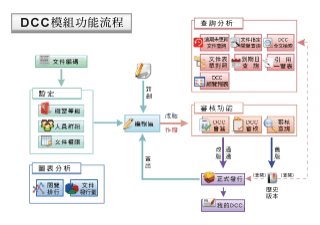
ISO four-tier documents unified with general document management:
ISO document version control conforms to the latest ISO standards and can be seamlessly linked with FMEA, CP, APQP, PPAP, MEET, and other BKM modules. General document management covers non-ISO documents that do not require the same rigorous control as ISO documents; through the general document management function, an enterprise can place large volumes of documents into this document library and enjoy full-text search, document preview, and access-permission management.
Document version and security:
Through document-release classification and procedures, the document lifecycle is governed—covering actions such as adding, retrieving, using, and obsoleting documents—and the security and consistency of each document are controlled according to individual access permissions.
The usage benefits of linked document release and search:
It provides designated viewing and overview reports of officially released documents, plus keyword and full-text search, effectively bringing knowledge benefits across the entire plant and even across plants. The citation index lets you understand the benefit of each document, and the function for documents past their due date that have not been updated keeps documents alive and active.
MEET Meeting & Task Management Module
Plants frequently convene meetings and assign tasks for R&D, production, quality, and plant administration management, and they want to build production performance through the P.D.C.A. continuous-improvement cycle. The MiDFUN Meeting Management module lets participants obtain sufficient information more efficiently; project managers can more proactively track the progress of subsequent corrective actions, and grasp meeting performance through the execution content and schedule.