


MiDFUN Product Module / SQP
Supplier collaboration portal connected to quality workflows
SQP gives suppliers a web-based entry point for quality tasks, documentation, inspection collaboration, and response tracking.
Best Fit
- Supplier self-service collaboration
- Incoming quality and audit data exchange
- Quality-response status tracking
Key Capabilities
- Supplier-facing task and document workflow
- Inspection and audit collaboration records
- Status visibility for buyers and quality teams
QRP Data Flow
SQP extends SQM workflows to suppliers so external quality actions can be captured inside the QRP data loop.
SQP Supplier Quality Portal
Supplier Quality Portal
Supplier collaboration portal|Supplier Portal|Integrates with your enterprise SCM supply chain management system
About this product
MiDFUN is a Taiwan-based software company dedicated to quality management systems for manufacturing. Founded in 1993, it has more than 30 years of system-development experience. Its core products include the SQM Supplier Quality Management System, SPC Statistical Process Control, and FMEA Failure Mode and Effects Analysis, among others.
The MiDFUN SQP Supplier Quality Portal is the external collaboration gateway of the SQM Supplier Quality Management System. It lets suppliers upload inspection reports, submit corrective actions, and respond to audit questionnaires directly through a web platform, with all data linked in real time to the buyer’s SQM system—replacing traditional back-and-forth email and paper-based workflows. Some enterprise customers integrate SQP into their internal procurement portal or SCM supply chain management system to serve as a unified supplier entry point.
Why do you need SQP?
In a traditional supplier-management workflow, IQC staff have to collect each supplier’s Certificate of Analysis (COA) from email, manually download it, and then upload or file it in the system. This is time-consuming and labor-intensive, and the data ends up scattered and hard to track. When a nonconformity occurs, staff must email the supplier; the 8D reports that come back vary in format, and closure progress is even harder to keep on top of.
The core value of the MiDFUN SQP Supplier Quality Portal lies in “sharing the workload with suppliers” and “unifying the data entry point.” Suppliers enter data directly into the system at the source, where it automatically connects to the buyer’s SQM system—so IQC and SQE staff are no longer stuck moving data around.
How SQM and SQP divide the roles
MiDFUN SQM and SQP are two complementary systems. Put simply, SQM is the “internal-facing” management system (used by the buyer’s quality assurance and IQC staff), while SQP is the “external-facing” interactive platform (used by suppliers to log in). SQP exists to turn communication that once lived in email and on paper into a digital workflow that links directly to the SQM system.
| System | Users | Key functions |
|---|---|---|
| SQM (internal-facing) | Buyer’s quality assurance / IQC / SQE | Incoming-material management, AQL sampling calculation, accept/reject judgment, MRB initiation, supplier scoring |
| SQP (external-facing) | Suppliers | Upload Certificate of Analysis (COA) and Certificate of Conformance (COC) reports, complete 8D/CLCA corrective-action reports, respond to audit questionnaires, view scoring results |
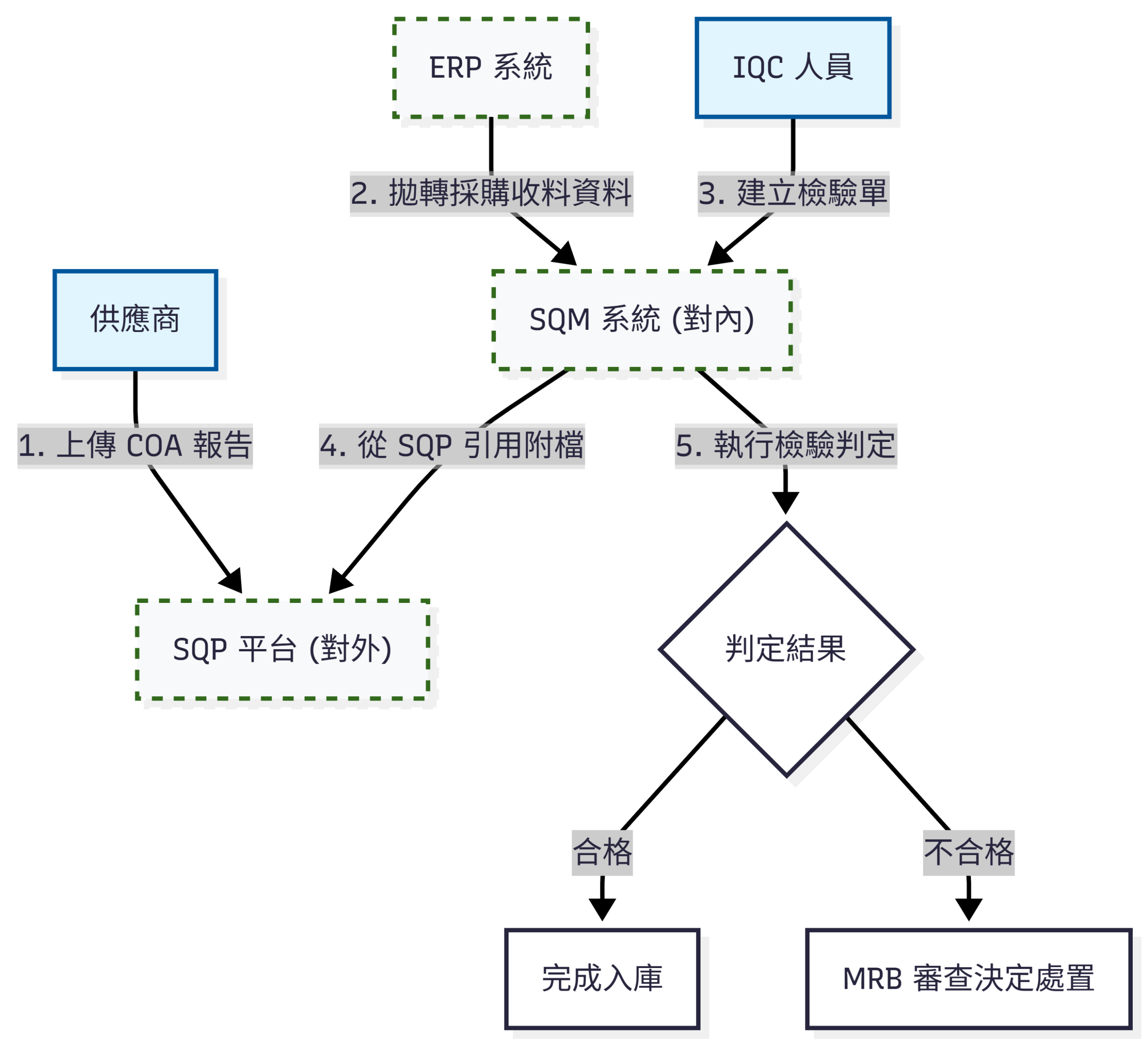
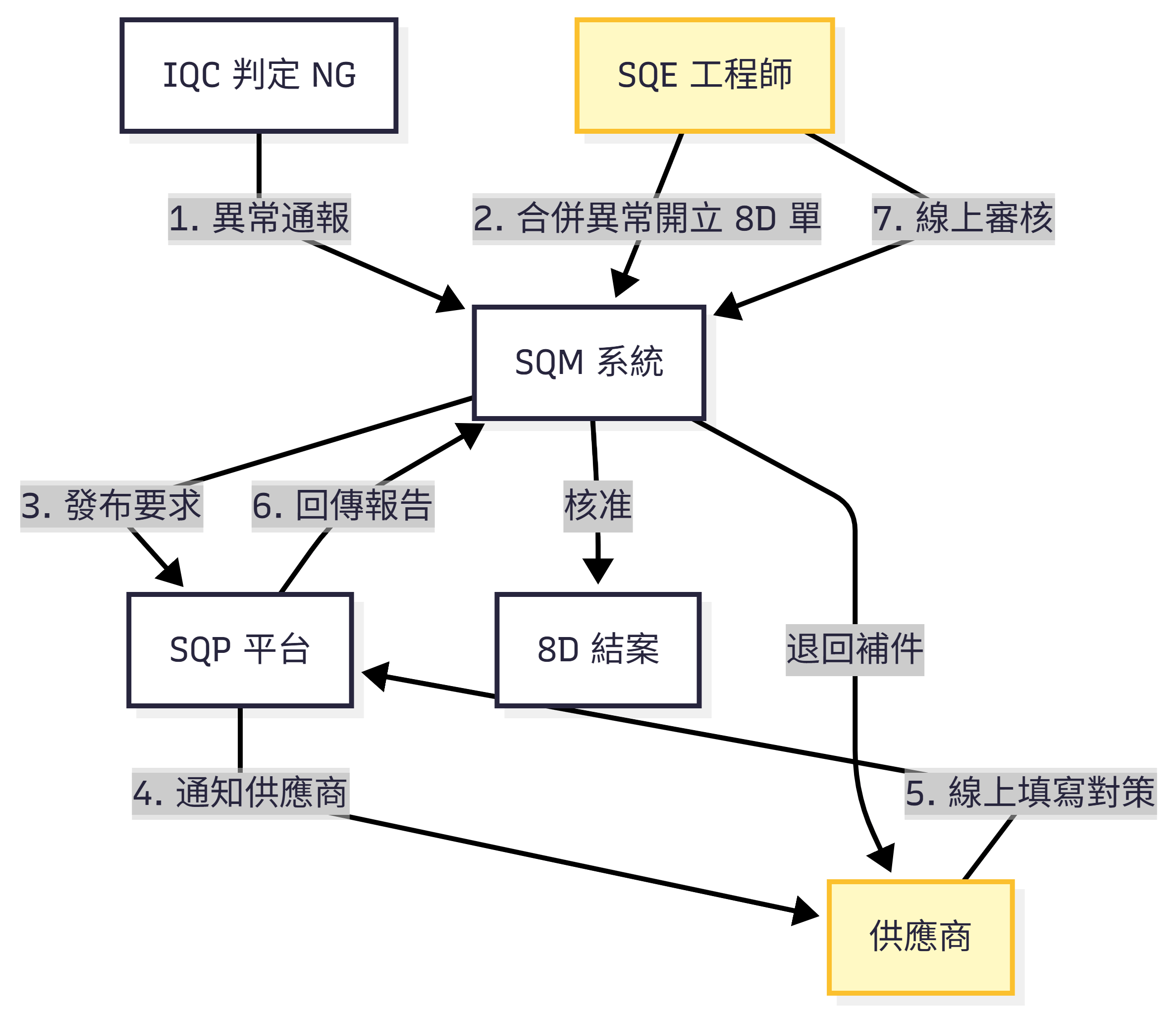
The three core capabilities of SQP
1. Automated management of COA / COC shipping reports
When suppliers ship goods, they log in to the MiDFUN SQP portal and upload inspection data or reports (PDF) directly. When the buyer’s IQC staff create an inspection record in SQM, they can simply choose “Add attachment from SQP,” and the system automatically pulls the files the supplier has already uploaded based on the purchase order number or lot number—with no further downloading or uploading required.
| Traditional pain point | SQP solution |
|---|---|
| IQC has to receive emails, download, and manually upload—slow and labor-intensive | Suppliers log in to SQP and upload inspection reports directly at the time of shipment |
| Data is scattered and hard to link to inspection records | When IQC creates an inspection record, the system automatically retrieves files by purchase order / lot number |
| Partial shipments require re-uploading the same report | A single SQP document can be referenced multiple times—no re-uploading needed |
Supported document types: Certificate of Analysis (COA), Certificate of Conformance (COC), Safety Data Sheet (SDS), SGS reports, 8D reports, SVHC (Substances of Very High Concern) declarations, QMS certificates, RoHS green-compliance documents, and more.
2. Digitalized complaint and nonconformity handling (8D/CAR)
After the MiDFUN SQM system flags an incoming-material nonconformity (NG), the SQE can “merge” one or more nonconformities into a single 8D/CAR record in the system and send it to the supplier through SQP—avoiding the issuance of multiple records when the same defect recurs. The supplier logs in to SQP to fill in the cause analysis and countermeasures; the data flows straight back to the buyer’s system, where the SQE can review it online and request additional information, and every step of the history is recorded.
| Traditional pain point | SQP solution |
|---|---|
| Suppliers are notified by email, and their replies come back in inconsistent formats | After SQM flags NG, the SQE can merge multiple nonconformities into a single 8D/CAR record and send it to SQP |
| 8D reports are hard to track to closure | Suppliers complete the report online, the SQE reviews it online, and the full history is recorded |
| Defect photos have to be forwarded by email via procurement | Suppliers view the defect photos uploaded by the buyer directly in SQP |
3. Supplier audit and assessment management
The MiDFUN SQP portal lets you set up an annual audit plan and automatically send notifications reminding suppliers to complete self-assessment forms or prepare materials. Suppliers can view their own quarterly scores or deficiency items on the platform, making scoring results transparent.
| Traditional pain point | SQP solution |
|---|---|
| Annual audit plans lack systematic reminders | The system sets up the annual audit plan and sends notifications automatically |
| Scoring results are opaque, so suppliers don’t know how they are performing | Suppliers can view their quarterly scores and deficiency items on the platform |
| After an announcement goes out, there’s no way to know whether suppliers received it | The buyer’s SQE can see suppliers’ read/unread status in real time |
Assessment grade levels: A Excellent / B Qualified / C Improvement required within a deadline / D Removed from the approved supplier list
Customer integration examples
Many enterprises integrate MiDFUN SQP into their internal procurement portal or SCM system. The following are real-world examples of how customers use it:
| Functional module | Function items |
|---|---|
| Announcement management | System announcements, announcements and qualification documents, supplier read/unread status tracking |
| Procurement information | Bid registration |
| Supplier tasks | Supplier cases, supplier changes, supplier document management, order management, delivery management, payment inquiry, Hub inventory inquiry, IQC zone, supplier part maintenance, penalty-notice management |
| Material management | ICP/SDS report review management, incoming-inspection specifications |
| Engineering platform | Engineering management, engineering part-number inquiry |
Note: The above are real-world examples of customers integrating SQP into an enterprise procurement portal. Functions can be customized and configured to each enterprise’s needs.
System integration capabilities
The MiDFUN SQP Supplier Quality Portal integrates seamlessly with your existing enterprise systems:
| Integration target | Integration description |
|---|---|
| SAP / Oracle ERP systems | Import purchase orders, supplier data, and material information |
| MiDFUN SQM system | Data uploaded by suppliers flows automatically into SQM, and nonconformity records are automatically published to SQP |
| MiDFUN SPC system | Real-time monitoring of IQC, IPQC, and OQC quality data with nonconformity alerts |
Implementation benefits
| Benefit area | Description |
|---|---|
| Lower management costs | Replaces manual email work and establishes a digital exchange platform between suppliers and the buyer |
| Standardized incoming-material workflow | Establishes in-house SOP standards, document-progress tracking, and user-permission management |
| Faster nonconformity handling | Online 8D/CAR review, MRB sign-off process, and full recording of accept/reject decisions |
| Paperless document management | Unified database architecture, complete retention of supplier-interaction history, and automatic control of document validity periods |
Representative customers
The MiDFUN SQM/SQP system has been validated and deployed by nearly a hundred enterprises across industries including electronics manufacturing, semiconductors, food, and automotive components:
Kingston Technology, Powertech Technology (PTI), Kinsus Interconnect Technology, FSP Technology, Uni-President Enterprises, SRAM, Kemitek Industrial, Standard Foods, Ying Ming Industry, Lite-On Semiconductor (Taiwan / Shanghai / Wuxi), Dianqi, Fushi Electronics, Taiflex Scientific, Hsi Sheng International, Sanho Industrial, Fu Chia Industrial, Yi Tai Technology, Han Yu Industrial, and Chieng Lung Hsing Gear, and more.
Glossary
Explanations of the technical terms mentioned in this article, to help you better understand the concepts behind supplier quality management.
Certificate of Analysis (COA)
A quality report provided by the supplier at the time of shipment, documenting the inspection data for that lot of material and its statement of conformance to specifications. The buyer’s IQC compares the Certificate of Analysis (COA) data against the actual sampling results to confirm the quality of incoming material.
8D (Eight Disciplines)
A structured problem-solving method originating from Ford, which addresses quality nonconformities systematically through eight steps: D1 form the team, D2 describe the problem, D3 interim containment action, D4 root-cause analysis, D5 select permanent corrective action, D6 implement and validate the corrective action, D7 prevent recurrence, and D8 closure and recognition. It has become the standard process for handling customer complaints in the automotive and electronics manufacturing industries.
Reference: AIAG, CQI-20 Effective Problem Solving Guide
MRB (Material Review Board)
When incoming inspection finds nonconforming product, a review meeting made up of departments such as quality assurance, engineering, and procurement jointly decides how to disposition the lot of material: use under concession, return, scrap, or rework.
IQC (Incoming Quality Control)
Sampling inspection of the raw materials delivered by suppliers, ensuring incoming quality meets specification requirements before the material is allowed into the warehouse. IQC is the first line of defense in quality management, effectively preventing defective material from reaching the production line.
Frequently asked questions
Q: What is the MiDFUN SQP Supplier Quality Portal?
A: The MiDFUN SQP Supplier Quality Portal is the external collaboration gateway of the SQM Supplier Quality Management System. Suppliers can log in to the web platform from devices such as a computer, tablet, or phone to upload the Certificate of Analysis (COA), submit 8D corrective actions, and respond to audit questionnaires, with all data linked in real time to the buyer’s SQM system.
Q: How are SQP and SQM related?
A: SQM is the “internal-facing” management system, used by the buyer’s quality assurance and IQC staff; SQP is the “external-facing” interactive platform, used by suppliers to log in. The data suppliers upload in SQP flows automatically into SQM for internal review and reference, and the nonconformity records or audit requirements generated by SQM are also published to SQP for suppliers to handle.
Q: How is SQP different from an SCM supply chain management system?
A: SCM (Supply Chain Management) is a supply chain management system covering aspects such as procurement, logistics, and inventory, whereas MiDFUN SQP focuses on supplier quality collaboration—including document upload, nonconformity handling, and audit assessment. Many enterprises integrate SQP into their internal SCM system or procurement portal to serve as the unified entry point for supplier quality management. The two are complementary: SQP handles in-depth management of the quality dimension, while SCM handles the broad integration of the supply chain.
Q: Do suppliers need to install software?
A: No. MiDFUN SQP is a pure web platform; suppliers simply log in with a browser to use it. It supports a wide range of devices—computers, tablets, and phones—and provides a bilingual Chinese and English interface.
Q: What documents can be uploaded to SQP?
A: Suppliers can upload a wide range of documents through the MiDFUN SQP portal, including: Certificate of Analysis (COA), Certificate of Conformance (COC), Safety Data Sheet (SDS), SGS reports, 8D corrective-action reports, SVHC (Substances of Very High Concern) declarations, QMS quality management system certificates, RoHS green-compliance documents, and more.
Q: How does the buyer’s IQC reference the data suppliers upload?
A: When IQC staff create an inspection record in the MiDFUN SQM system, they can choose “Add attachment from SQP,” and the system automatically retrieves the files the supplier has already uploaded based on the purchase order number or lot number—with no further manual downloading or uploading. Even when a supplier ships in multiple lots, the same document can be referenced multiple times.
Q: What information can suppliers see on the platform?
A: After logging in to the MiDFUN SQP portal, suppliers can view: announcements issued by the buyer, complaint and nonconformity records (including defect photos), Engineering Change Notices (ECN), audit questionnaires, and their own quarterly scores and deficiency items. The complete interaction history is fully recorded.
Q: What kind of company is MiDFUN?
A: MiDFUN is a Taiwan-based software company dedicated to quality management systems for manufacturing. Founded in 1993, it has more than 30 years of system-development experience. Its services span industries including electronics manufacturing, automotive electronics, semiconductors, food, and aerospace, and it provides a complete quality management solution covering SQM, SPC, FMEA, MSA, 8D, and more.
Want to learn more?
If your enterprise is looking for a supplier collaboration solution, get in touch with MiDFUN to learn how the
MiDFUN SQM Supplier Quality Management System
and the SQP Supplier Quality Portal can help you improve supply chain management efficiency.
MiDFUN has more than 30 years of dedicated experience in manufacturing quality management, providing complete solutions including SQM, SPC, FMEA, MSA, and 8D.
Contact us