



2026.04.01 | MiDFUN Editorial Team
Cpk & Ppk Process Capability Analysis Complete Guide: Formulas, Interpretation, and IATF 16949 Requirements
About this article | Cpk and Ppk are core metrics for measuring process capability, and they are also mandatory items in IATF 16949 and customer PPAP reviews. This article provides a complete breakdown of formula derivation, numerical interpretation, the connection to Six Sigma, and how the MiDFUN SPC system automatically calculates and monitors process capability in real time. If you are looking for an introductory overview of Cpk/Ppk, you can first read the Cpk and Ppk definitions page.
Process Capability Indices Overview
In Statistical Process Control (SPC), Cp, Cpk, Pp, and Ppk are the four most commonly used process capability indices. They measure the relationship between process output and specifications from different angles, helping engineers judge whether a process is capable of stably producing conforming parts.
The core differences among these four indices lie along two dimensions: whether process offset is taken into account, and which variation estimation method is used. The table below summarizes the full comparison of the four:
| Index | Full name | Factors considered | Source of variation | When to use |
|---|---|---|---|---|
| Cp | Process Capability | Spread only | Within-subgroup variation (σ̂) | Assessing process potential |
| Cpk | Process Capability Index | Spread + offset | Within-subgroup variation (σ̂) | Short-term process capability |
| Pp | Process Performance | Spread only | Overall variation (s) | Long-term process potential |
| Ppk | Process Performance Index | Spread + offset | Overall variation (s) | Long-term process capability |
Put simply: Cp/Pp measure the process’s “potential” (how good the capability would be if the process were perfectly centered on the specification midpoint), while Cpk/Ppk measure the process’s “actual performance” (taking the offset of the mean into account). Cp and Cpk use the within-subgroup standard deviation (a short-term view), whereas Pp and Ppk use the overall standard deviation (a long-term view).
Cpk Formula Derivation and Calculation Example
Cpk is the process capability index most often cited in practice. It accounts for both the spread width and the center offset of the process, faithfully reflecting the process’s short-term production capability.
Formula definition
Cp = (USL – LSL) / 6σ̂
Cpk = min[ (USL – X̄) / 3σ̂ , (X̄ – LSL) / 3σ̂ ]
where the within-subgroup standard deviation estimate is:
σ̂ = R̄ / d₂
Explanation of the symbols in the formulas:
- USL (Upper Specification Limit): the upper specification limit
- LSL (Lower Specification Limit): the lower specification limit
- X̄: the process mean (the grand average of all subgroup means)
- σ̂: the within-subgroup standard deviation estimate, reflecting short-term (common-cause) variation
- R̄: the average of the ranges of the individual subgroups
- d₂: a constant looked up by subgroup size (e.g., d₂=2.326 when n=5)
Cpk takes the smaller of the two capability values “toward the upper limit” and “toward the lower limit,” because process capability is limited by the weaker side. When Cpk = Cp, the process is perfectly centered; when Cpk < Cp, the process has an offset.
Full calculation example
Problem: a part’s outer-diameter specification is 10.00 ± 0.05 mm
- USL = 10.05 mm, LSL = 9.95 mm
- 25 subgroups measured, 5 samples per subgroup
- X̄ = 10.01 mm, R̄ = 0.025 mm
- d₂ (n=5) = 2.326
Step 1: Calculate the within-subgroup standard deviation
Step 2: Calculate Cp
Step 3: Calculate Cpk
CPL = (X̄ – LSL) / 3σ̂ = (10.01 – 9.95) / (3 × 0.01075) = 0.06 / 0.03225 = 1.86
Cpk = min(1.24, 1.86) = 1.24
Interpretation:
Cp = 1.55 indicates that the process spread has ample potential relative to the specification width. However, Cpk = 1.24 is markedly lower than Cp, indicating that the process mean is shifted toward the USL (X̄ = 10.01 is above the specification midpoint of 10.00). Although it is still within the conforming range of Cpk ≥ 1.00, it does not reach 1.33, the IATF 16949 mass-production requirement, so the process center needs to be adjusted 0.01 mm toward the LSL.
Ppk Formula Derivation and Calculation Example
The structure of the Ppk formula is exactly the same as that of Cpk; the only difference is that Ppk uses the overall standard deviation s (the standard deviation of all individual observations) instead of the within-subgroup standard deviation estimate σ̂. This allows Ppk to capture the additional between-subgroup variation, more faithfully reflecting long-term process performance.
Formula definition
Pp = (USL – LSL) / 6s
Ppk = min[ (USL – X̄) / 3s , (X̄ – LSL) / 3s ]
where:
s = √[ Σ(xᵢ – X̄)² / (N-1) ] (the standard deviation of all individual observations)
Continuing the calculation example
Continuing the outer-diameter case above, suppose the overall standard deviation of the 125 observations is s = 0.013 mm (slightly larger than the within-subgroup estimate of 0.01075 mm).
Calculate Pp:
Calculate Ppk:
PPL = (10.01 – 9.95) / (3 × 0.013) = 0.06 / 0.039 = 1.54
Ppk = min(1.03, 1.54) = 1.03
Interpretation:
Ppk = 1.03 is markedly lower than Cpk = 1.24, the gap stemming from the overall standard deviation s (0.013) being larger than the within-subgroup standard deviation σ̂ (0.01075). This indicates that there are additional sources of between-subgroup variation, such as different shifts, different material batches, or changes in ambient temperature. Ppk does not reach 1.67, the early-stage requirement of PPAP, so reducing the between-subgroup variation should be the priority.
Cpk vs Ppk In-Depth Comparison
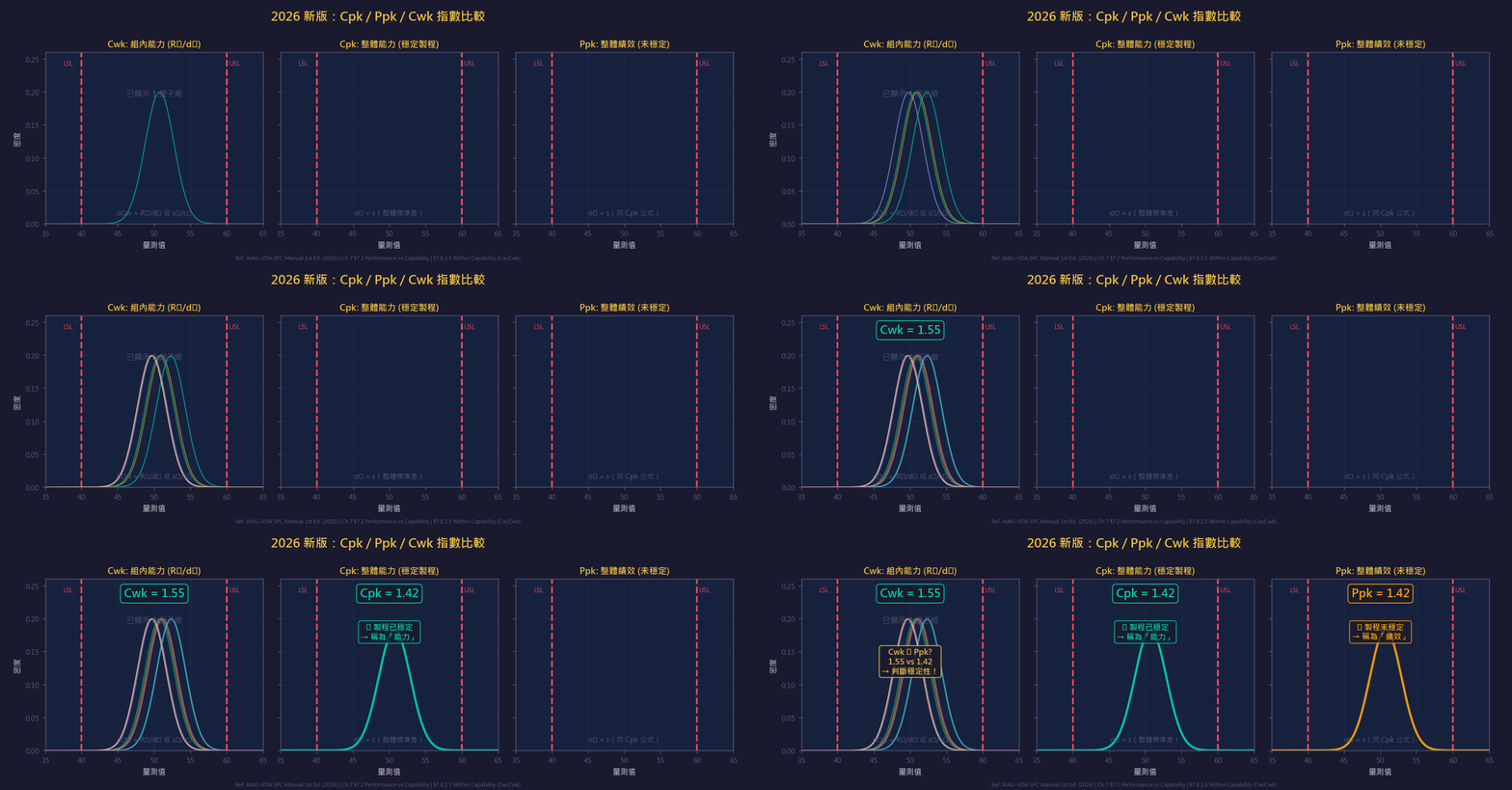
Understanding the difference between Cpk and Ppk is the key to using process capability indices correctly. The two are structurally identical in their formulas, differing only in the way variation is estimated, yet this single difference reflects two entirely different quality perspectives.
| Comparison item | Cpk | Ppk |
|---|---|---|
| Source of variation | Within-subgroup variation (σ̂ = R̄/d₂) | Overall variation (s) |
| Assessment period | Short-term | Long-term |
| Sensitivity to between-subgroup variation | Less sensitive (reflects within-subgroup only) | More sensitive (includes within- + between-subgroup) |
| PPAP early sample-submission requirement | — | Ppk ≥ 1.67 |
| Ongoing mass-production monitoring requirement | Cpk ≥ 1.33 | — |
| Calculation prerequisite | Process must first be stable (no OOC on the control chart) | Does not require a stable state |
| Relationship between the values | Usually ≥ Ppk | Usually ≤ Cpk |
According to the definition in the AIAG SPC Reference Manual, Cpk applies to the capability assessment of a process that is in a state of statistical control, whereas Ppk applies to the performance assessment of an initial process study or a process whose stability has not yet been confirmed. In the AIAG-VDA SPC Reference Manual, the two are positioned as complementary indices, and it is recommended that both be calculated and the differences compared.
Practical rule of thumb: if the Cpk and Ppk values are close, the process is stable and the between-subgroup variation is small; if Cpk is markedly larger than Ppk, there is significant between-subgroup variation and the special cause needs to be investigated further.
Numerical Interpretation and Acceptance Criteria
The following are the industry-standard criteria for interpreting Cpk, which apply equally to the interpretation of Ppk. IATF 16949 and most automaker customers use Cpk ≥ 1.33 as the mass-production threshold, while the early PPAP stage requires Ppk ≥ 1.67.
| Cpk range | Grade | Meaning | Corresponding Sigma | Corresponding DPMO |
|---|---|---|---|---|
| < 1.00 | Unacceptable | Insufficient process capability, high defect rate | < 3σ | > 2,700 |
| 1.00 – 1.33 | Marginally acceptable | Continuous improvement needed | 3 – 4σ | 66 – 2,700 |
| 1.33 – 1.67 | Acceptable | IATF 16949 mass-production standard | 4 – 5σ | 0.6 – 66 |
| 1.67 – 2.00 | Excellent | PPAP early sample-submission standard | 5 – 6σ | 0.002 – 0.6 |
| > 2.00 | Outstanding | Six Sigma level | ≥ 6σ | < 0.002 |
It is worth noting that the correspondence between Sigma Level and DPMO in the table above assumes a 1.5σ long-term shift (the Motorola convention). In the theoretical case where no offset is considered, a Cpk of 1.00 corresponds to a defect rate of 2,700 ppm (0.27%), while a Cpk of 2.00 corresponds to a defect rate of nearly zero.
The Connection Between Cpk and Six Sigma
There is a direct mathematical relationship between Cpk and Six Sigma. The Sigma Level represents how many standard deviations the process mean is from the nearest specification limit, and Cpk is precisely that distance divided by 3:
that is, Sigma Level = 3 × Cpk
Below is the complete conversion table for Cpk, Sigma Level, and DPMO:
| Cpk | Sigma Level | DPMO (short-term) | Defect rate |
|---|---|---|---|
| 0.33 | 1σ | 317,311 | 31.73% |
| 0.67 | 2σ | 45,500 | 4.55% |
| 1.00 | 3σ | 2,700 | 0.27% |
| 1.33 | 4σ | 63 | 0.0063% |
| 1.67 | 5σ | 0.57 | 0.000057% |
| 2.00 | 6σ | 0.002 | 0.0000002% |
This conversion relationship makes Cpk the most intuitive language for businesses to communicate process capability. For example, when a customer requires Cpk ≥ 1.33, this is in essence a requirement to reach a 4 Sigma level, i.e., no more than 63 defective parts per million.
Common Pitfalls and Best Practices
When carrying out process capability analysis in practice, the following three pitfalls are the most common, and even experienced quality engineers may overlook them.
Pitfall 1: Calculating Cpk without enough data
The statistical meaning of Cpk rests on a sufficient sample size. According to the recommendation in the AIAG SPC Reference Manual, an initial process study requires at least 25 subgroups; if 5 samples are taken per subgroup, that means 125 or more data points. When the sample size is insufficient, the confidence interval of Cpk is too wide and the value is of no reference value.
Best practice: when reporting a Cpk value, also note the sample size and the confidence interval. If the data is insufficient, present it first as a Preliminary Cpk and note that it is a preliminary assessment result.
Pitfall 2: Calculating Cpk when the process is unstable
The premise of Cpk is that the process is in a state of statistical control (i.e., only common-cause variation is present). If there is an OOC (Out of Control) signal on the control chart, it indicates that a special cause is acting on the process, and the Cpk calculated in this case is meaningless because the process behavior is unpredictable.
Best practice: first use a control chart (X̄-R chart or X̄-S chart) to confirm that the process is stable, eliminate the special causes of all OOC points, and only then calculate Cpk. Before calculating Cpk, the MiDFUN SPC system automatically runs the seven AIAG-VDA stability decision rules to ensure that the calculation prerequisites are met.
Pitfall 3: High Cpk but low Ppk
When Cpk is significantly higher than Ppk (for example, Cpk = 1.50 but Ppk = 1.05), it indicates that the process performs well in the short term but that additional sources of variation exist in the long term. These between-subgroup variations typically come from:
- Shift differences: inconsistent techniques or settings among different operators
- Equipment differences: systematic bias between multiple machines
- Material batch differences: fluctuations in the characteristics of raw materials from different batches
- Environmental factors: changes in temperature and humidity over time
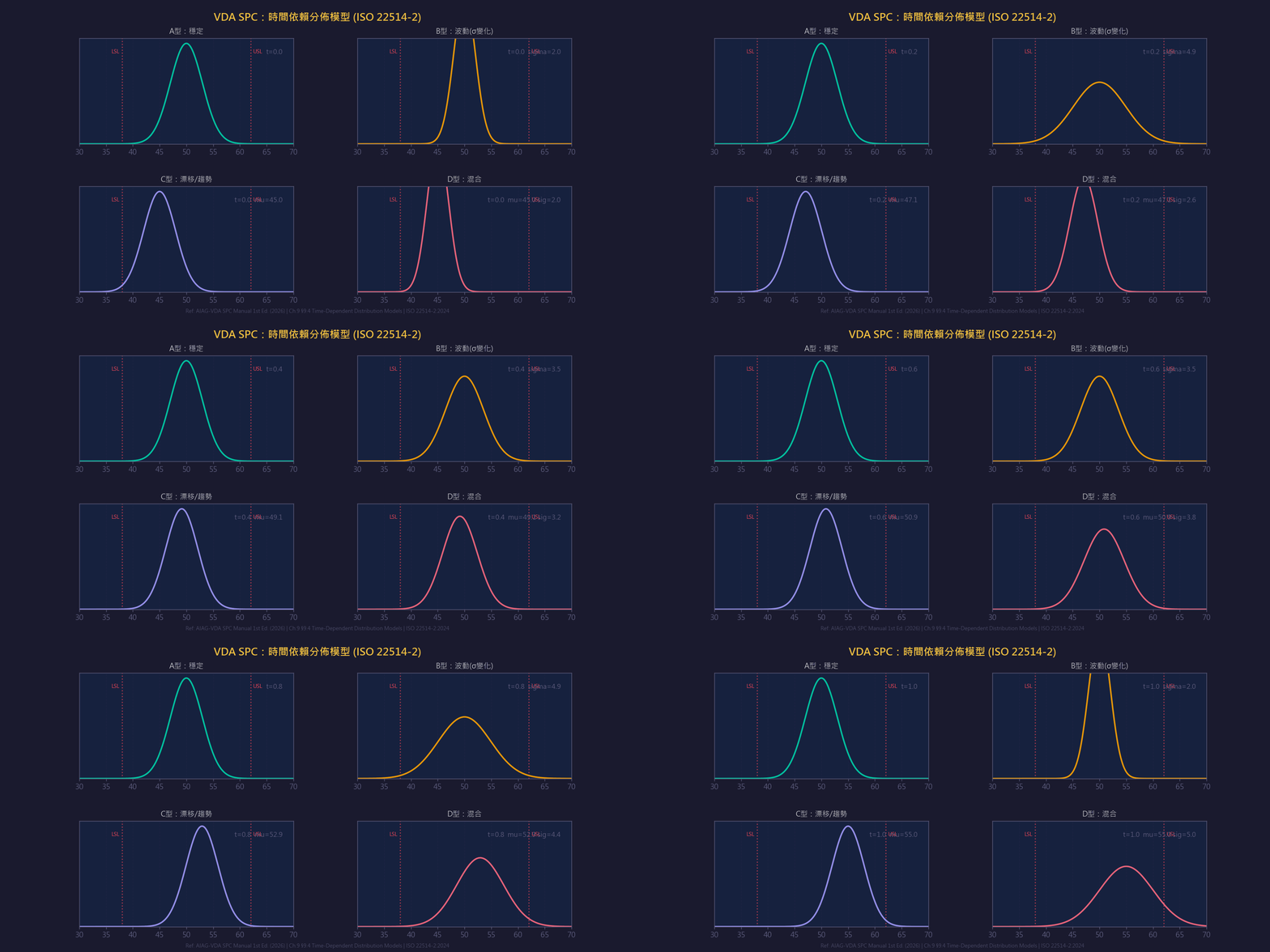
Best practice: when you find the Cpk-Ppk gap is too large, you should use stratification to identify the sources of variation. The MiDFUN SPC system supports stratified Cpk calculation by shift, equipment, material batch, and other strata, quickly pinpointing the root cause of the problem.
Cpk/Ppk Features of the MiDFUN SPC System
The MiDFUN SPC system has been dedicated to manufacturing quality management for over 30 years, accumulating hands-on experience from serving more than 500 factories. In the area of Cpk/Ppk process capability analysis, the system provides the following core features:
- Real-time automatic calculation: once measurement data is entered, the system instantly calculates Cp/Cpk/Pp/Ppk, with no waiting for manual consolidation. It supports automatic connection with measuring instruments (CMMs, vernier calipers, etc.), with data fed directly into the database for calculation.
- Trend monitoring and early warning: it tracks long-term changes in the Cpk trend, and when Cpk approaches the management threshold it automatically issues an early-warning notification (Email, LINE, Teams), allowing engineers to intervene before the problem worsens.
- Pre-calculation stability check: before calculating Cpk, it automatically runs the seven AIAG-VDA stability decision rules (Nelson Rules), and only outputs the Cpk value after confirming that the process is in a state of control, avoiding the error of “Pitfall 2.”
- Stratified analysis: it supports stratified Cpk calculation by dimensions such as shift, machine, material lot number, and cavity, quickly pinpointing the source of between-subgroup variation.
- AIAG standard report export: with one click, it generates a process capability report in the AIAG format (including a histogram, normal distribution curve, and Cp/Cpk/Pp/Ppk values), which can be exported as PDF or Excel and submitted to the customer directly as a PPAP documentation package.
For the high-mix, low-volume production mode, the system additionally provides a Pre-Control chart and small-sample Cpk estimation, so that even with limited data it can still provide an effective process capability assessment.
Glossary Quick Reference
- Cp (Process Capability): the process potential index, measuring only the ratio of the spread width to the specification width, without considering offset.
- Cpk (Process Capability Index): the process capability index, accounting for both spread and offset, reflecting short-term actual process capability.
- Pp (Process Performance): the process performance potential index, using the overall variation estimate, without considering offset.
- Ppk (Process Performance Index): the process performance index, using the overall variation estimate and accounting for offset, reflecting long-term process performance.
- USL / LSL (Upper/Lower Specification Limit): the upper/lower specification limit, defined by the product design or customer requirements.
- σ̂ (Sigma Hat): the within-subgroup standard deviation estimate, calculated as R̄/d₂ or S̄/c₄, reflecting only common-cause variation.
- d₂: a constant looked up by subgroup size n, used to estimate σ̂ from R̄. Common values: 1.693 when n=3, 2.059 when n=4, 2.326 when n=5.
- OOC (Out of Control): an abnormal signal on the control chart, indicating that special-cause variation is present in the process.
- DPMO (Defects Per Million Opportunities): defects per million opportunities, used to measure the defect level of a process.
- PPAP (Production Part Approval Process): the Production Part Approval Process, the customer approval process before mass production.
Frequently Asked Questions (FAQ)
Q1: What exactly is the difference between Cpk and Ppk? When do you look at which one?
Cpk uses the within-subgroup standard deviation (σ̂) and reflects short-term process capability; its prerequisite for calculation is that the process has reached a state of statistical control. Ppk uses the overall standard deviation (s) and reflects long-term process performance, without requiring the process to be stable. In practice, in the early PPAP sample-submission stage you look at Ppk (typically required ≥ 1.67), and after entering mass production you continuously monitor Cpk (typically required ≥ 1.33). Both should be calculated together and their difference compared; if Cpk is far greater than Ppk, it means the between-subgroup variation needs attention.
Q2: What should I do if the customer requires Cpk ≥ 1.33 but I cannot reach it?
First use a control chart to confirm the process is stable, then determine the type of problem: if Cp ≥ 1.33 but Cpk is low, this indicates an offset problem, and you need to adjust the process center (for example, adjusting the tool offset or die position); if Cp itself is low, this indicates a spread problem, and you need to reduce process variation (for example, improving fixture precision or reducing environmental fluctuations). The MiDFUN SPC system can automatically diagnose the direction and magnitude of the offset and display the improvement priority with red-yellow-green status lights.
Q3: Is there a difference between calculating Cpk in Excel and calculating it with an SPC system?
The formulas are identical, but manual operation in Excel is error-prone: inconsistent subgrouping, mistakes looking up d₂ in the table, calculating without first confirming process stability, failure to exclude outliers, and so on. A professional SPC system like the MiDFUN SPC system automatically performs subgrouping, table lookups, stability checks, and outlier handling, ensuring that the calculated results are correct and consistent. More importantly, the system can continuously update Cpk in real time, rather than the “snapshot-style” static calculation of Excel.
Q4: How do you calculate Cpk for high-mix, low-volume production? What if there isn’t enough data?
Traditional Cpk requires at least 25 subgroups (about 125 data points), and high-mix, low-volume production does indeed face the challenge of insufficient data. Alternatives include: (1) using Preliminary Cpk together with a wider confidence interval; (2) using a Pre-Control chart as an alternative monitoring method; (3) using historical data from a similar process to establish a baseline. The MiDFUN SPC system supports small-sample Cpk calculation and a Pre-Control feature, providing effective quality assurance even in a high-mix, low-volume environment.
Q5: Can the MiDFUN SPC system automatically export Cpk reports for customers?
Yes. The MiDFUN SPC system supports the automatic generation of process capability reports in the AIAG standard format, with report contents including Cp/Cpk/Pp/Ppk values, histograms, normal distribution curves, control charts, and other complete information. These can be exported as PDF or Excel and submitted to the customer directly as part of the PPAP documentation package, with no need for additional manual consolidation. The system also supports batch export of reports for multiple monitored items, greatly reducing the report-preparation time for quality assurance staff.
Make Cpk/Ppk calculation no longer a burden
The MiDFUN SPC system calculates automatically, monitors in real time, and exports PPAP reports with one click
Further reading:
- What Are Cpk and Ppk? An Introductory Definitions Guide
- What Is SPC Statistical Process Control?
- SPC Control Chart Types and Selection Guide
- A Complete Introduction to Six Sigma
- Standard Deviation (Sigma): Definition and Application
- PPAP Production Part Approval Process
- An Analysis of the AIAG-VDA SPC Yellow Book
- SPC Quality Strategy for High-Mix, Low-Volume Production
- MiDFUN SPC Statistical Process Management System
Copyright © 2026 MiDFUN Co., Ltd. Some rights reserved
Author: Pei-Chi Chiu. First published: 2026-03-31. Type: QC Column
Original link: https://www.midfun.com.tw/qc/spc-cpk-ppk-process-capability-analysis/
This work is released under the Creative Commons Attribution-NonCommercial-NoDerivatives 4.0 International License (CC BY-NC-ND 4.0). You are welcome to share it freely, provided you credit the original author, include the original link, do not use it commercially, and do not modify the content.
Suggested citation format: Chiu, Pei-Chi (2026). “Cpk & Ppk Process Capability Analysis Complete Guide: Formulas, Interpretation, and IATF 16949 Requirements.” MiDFUN QC Column.
For reprint authorization and content inquiries: midfun@midfun.com.tw