


最後更新:2026.06.22
TTY Biopharm Company Limited was established in July 1960 and is one of the top three generic-drug manufacturers in Taiwan, focusing primarily on the development of special-dosage-form drugs and international-market marketing. After obtaining the drug license for “Lipo-Dox liposomal injection” in 1998, it became the world’s third biotech pharmaceutical company to possess liposome manufacturing technology. It has also long been a GMP-certified manufacturer.
Motivation for Adoption
For a long time, TTY Biopharm relied on paper records and EXCEL spreadsheets to carry out equipment maintenance work. This traditional approach could still cope when the number of pieces of equipment was small, but as the company expanded in scale and the number of pieces of equipment grew, the maintenance process became cumbersome and time-consuming, with no advance notification or overdue notification, and when things got complicated staff could forget. Each time, completing one full maintenance cycle—from data collection, scheduling, and execution to confirmation—required a great deal of manpower and time, greatly affecting work efficiency.
To improve equipment maintenance efficiency, the company’s internal equipment department drew up a preliminary system architecture, hoping to develop an equipment maintenance system on its own. However, although the IT department had the development capability, this work required a large investment of time and cost, especially given that there were already many other projects underway in the plant at the same time, which made such a development plan difficult to realize.
After a round of evaluation, TTY Biopharm decided to bring in an external equipment maintenance system to meet its existing needs and improve current practices. Following market research, TTY Biopharm ultimately chose the MiDFUN-TPM system.
-
Production Equipment Information Management
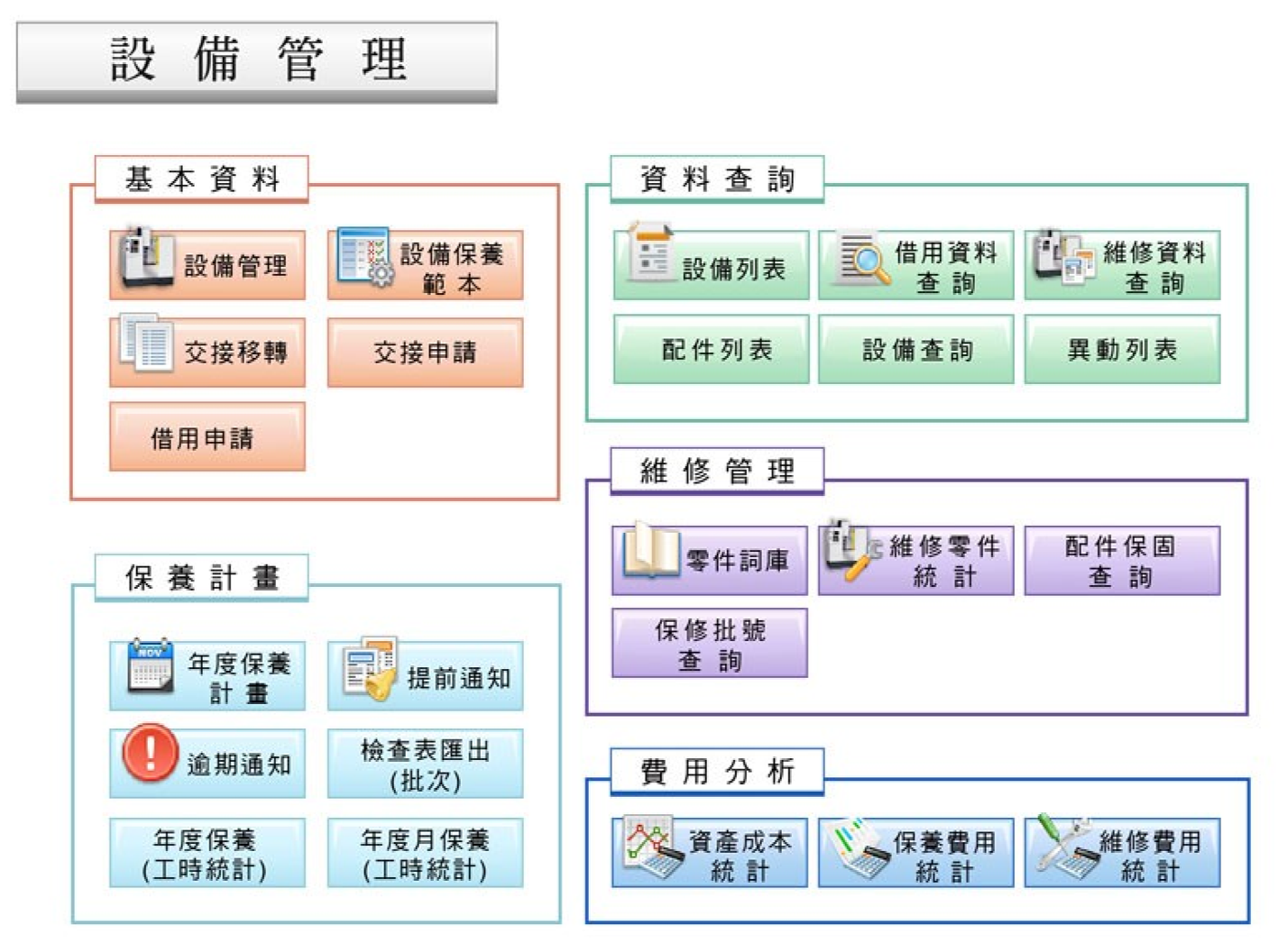
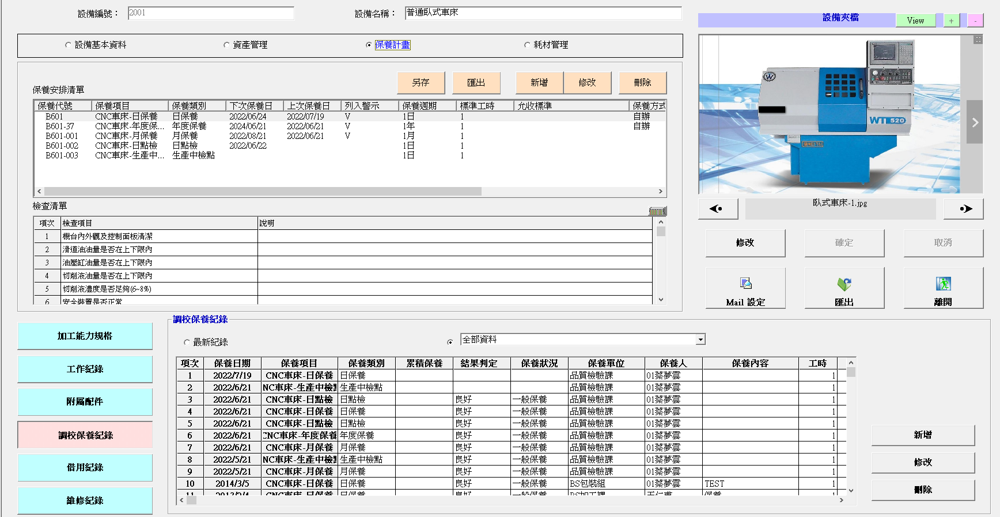
The MiDFUN-TPM system can build a detailed equipment information database, containing the basic information, technical parameters, operating manuals, and repair records of each piece of equipment. This not only makes it convenient for maintenance staff to consult equipment data at any time, but also provides strong support for maintenance decisions.
-
Equipment Maintenance Templates
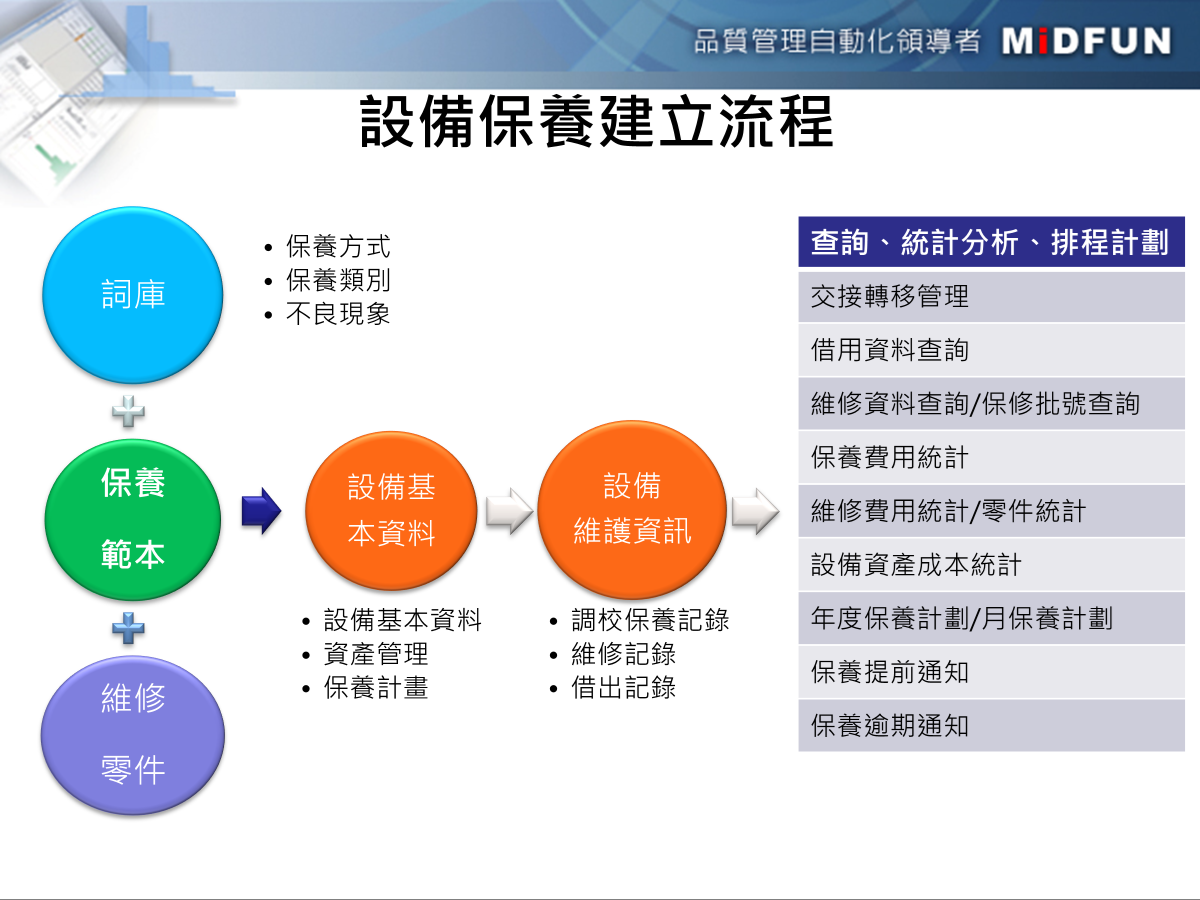
The system has multiple built-in equipment maintenance templates, and we can select the appropriate template according to different types of equipment to standardize the maintenance process. This ensures that each maintenance task is performed according to established standards, guaranteeing maintenance quality.
-
Advance / Overdue Notifications
The MiDFUN-TPM system can automatically send advance notifications based on the configured maintenance cycle, reminding maintenance staff to arrange maintenance work in time. If an overdue situation occurs, the system also issues a warning, avoiding equipment failures caused by maintenance not being performed in time.
-
Glossary Construction
The system provides a comprehensive glossary management function, systematically managing all maintenance-related vocabulary, terminology, and technical parameters, making it convenient for maintenance staff to quickly find the information they need when carrying out equipment maintenance.
-
Equipment Repair Management
The MiDFUN-TPM system also features a powerful equipment repair management function, able to record in detail the cause, process, and result of each equipment repair, providing a reference for future maintenance work and gradually improving the operating reliability of the equipment.
-
New Equipment Maintenance
For newly introduced equipment, the MiDFUN-TPM system can quickly establish a maintenance plan, ensuring that new equipment can receive effective maintenance in a timely manner after being put into use, extending the equipment’s service life.
-
Equipment Instrument Calibration Management
The system also provides an equipment instrument calibration management function, ensuring that all kinds of instruments maintain high precision during use, avoiding production problems caused by instrument error.

Benefits After Adoption
1. Management dimension
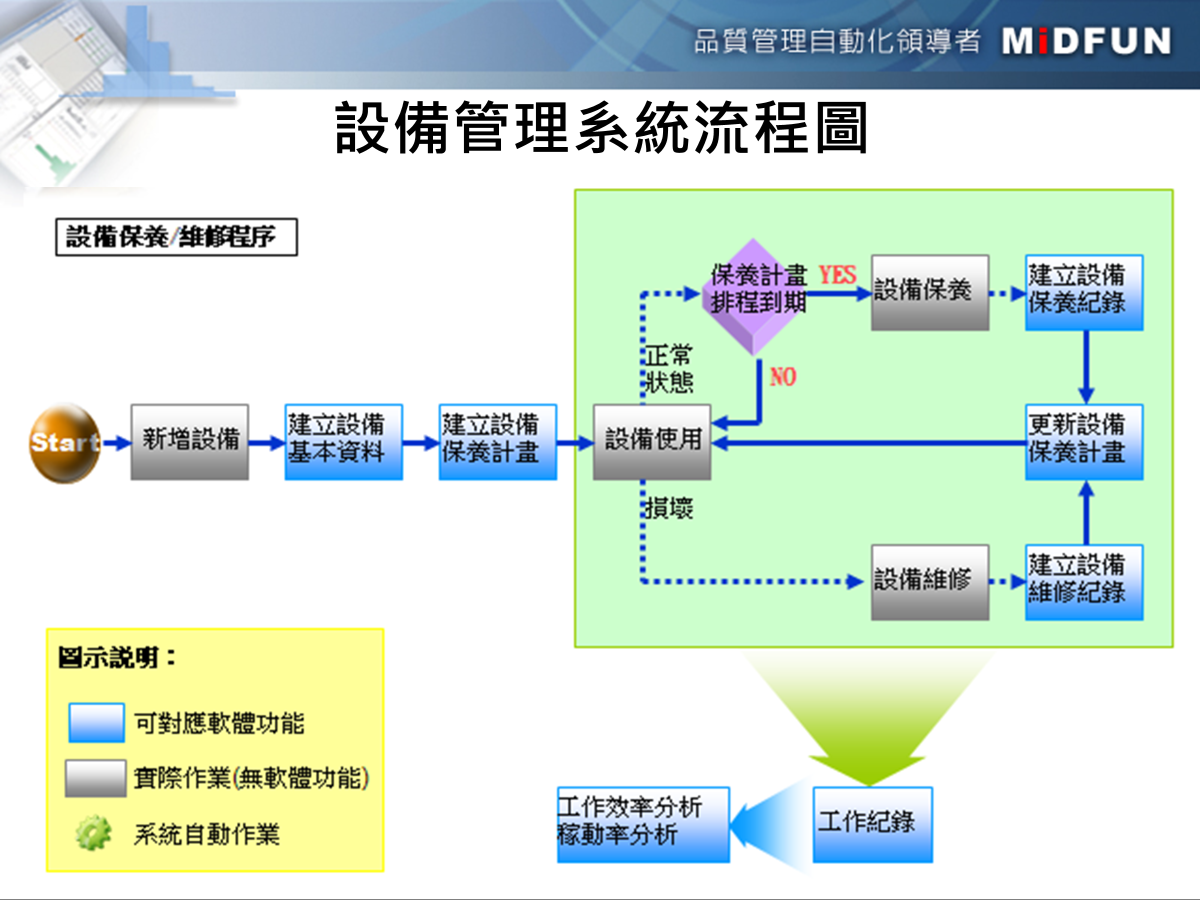
Systematic management provides comprehensive control over the data and maintenance status of all equipment, making it easy to query and analyze the operating condition and repair records of equipment, ensuring that every piece of equipment receives timely maintenance and repair, reducing equipment failures and downtime.
2. Reduced labor cost
Through the system’s automated processes, we no longer need to maintain via EXCEL. The system automatically records and updates equipment data, avoiding manual-entry errors and saving a great deal of time and effort.
3. Reduced IT development cost
In addition, the IT department no longer needs to spend a large amount of time and resources developing and maintaining a custom equipment management tool. The standardized system provides stable and reliable support, allowing IT staff to focus on more important project development and innovation work.
This not only makes equipment management simpler and more efficient, but also greatly lowers labor and IT costs, improves the accuracy and timeliness of equipment management, and ultimately delivers significant benefits.
This system has gone through the professional guidance and suggestions provided by many customers across different industries, continuously improving and strengthening its functions and operating procedures. The system has been verified by customers to achieve very good benefits. We list here some of the management difficulties that factories have often encountered in the past, along with a brief explanation of the KPIs or CP achieved through this system:
|
Category |
Plant Management Items Assisted by the TMH System |
System Adoption Benefits |
| Inspection Instruments | Periodic instrument calibration management (proactive notification and tracking) | Saves about 1/2 or more of the manpower |
| Full digitization of instrument calibration record reports | Establishes a complete inspection traceability system | |
| Control and analysis of instrument precision, repeatability and reproducibility, and stability | Complies with ISO and TS16949 specifications
Ensures instrument reliability and customer audits |
|
| Standardized assessment of personnel inspection count and appearance | Ensures consistent inspection-judgment standards among personnel | |
| Analysis of instrument repair, custody, change, and various costs
Provides professional charts |
Complete instrument asset management, saving 1/2 or more of the manpower | |
| Instrument vendor calibration qualification management | Records vendor service and certificate management | |
| Production Equipment | Periodic equipment maintenance management (proactive notification and tracking) | Saves about 2/3 or more of the manpower |
| Equipment repair requests and problem-cause analysis
and repair-component stocking |
Performs preventive maintenance through repair-case analysis, ensuring machines remain in good condition | |
| Complete management of equipment component assets and warranty periods | Establishes a complete asset management mechanism | |
| Management of the relevant tooling required for equipment-processed products | Configures the tooling needed for processing through the system, building an experience base and saving 1/2 of the manpower | |
| Analysis of various equipment costs and anomalies | Advanced rapid analysis lets management grasp the current situation | |
| Processing Tooling | Management of the processing-tooling checkout and return procedure | 1. Improves the confusion of borrowing and returning processing tooling, strengthening efficiency by 2/3 or more
2. Controls the processing history and benefits of tooling 3. Inventory turnover and lead-time procurement management 4. Applied to molds, cutting tools, jigs, consumables, and various processing tooling |
| Processing-tooling inventory and transfer use and procurement notification | ||
| Complete processing-history records of processing tooling | ||
| Complete repair and borrowing information of processing tooling | ||
| Analysis of processing-tooling consumption life and usage benefits | ||
| Production Utilization | Registration of production-processing information | 1. Saves 1/2 or more of production-information registration
2. Grasps the utilization of personnel and machines 3. Complete analysis of production performance 4. Builds product production-technology data |
| Production utilization-rate report analysis (personnel, machines) | ||
| Compilation of flexible production-utilization formulas | ||
| Efficiency analysis of standard work hours versus actual work hours | ||
| Setup and review of production-technology data | ||
| Personnel Skills | Personnel job-skill and manpower-allocation planning | Makes the training for personnel job-skill requirements systematic, structured, procedural, and analyzable professional management This system conforms to the TTQS management spirit, letting the factory save 2/3 or more of the manpower |
| Personnel training-assessment scheduling notification and registration | ||
| Personnel qualification certification | ||
| Establishment of the Personnel Training Quality Assessment System (Taiwan Train Quality System TTQS) | ||
| Analysis of courses, assessments, manpower, and job duties | ||