


最後更新:2026.06.21
Kinsus Interconnect Technology Corp., since its establishment in September 2000, has made the R&D, manufacturing, and sales of IC packaging substrates its core business. Kinsus plays a key role in the semiconductor industry chain. As global manufacturing accelerates its transformation and technology advances day by day, Kinsus has actively invested in smart manufacturing and regards a green supply chain as a focal point of its corporate sustainable development.
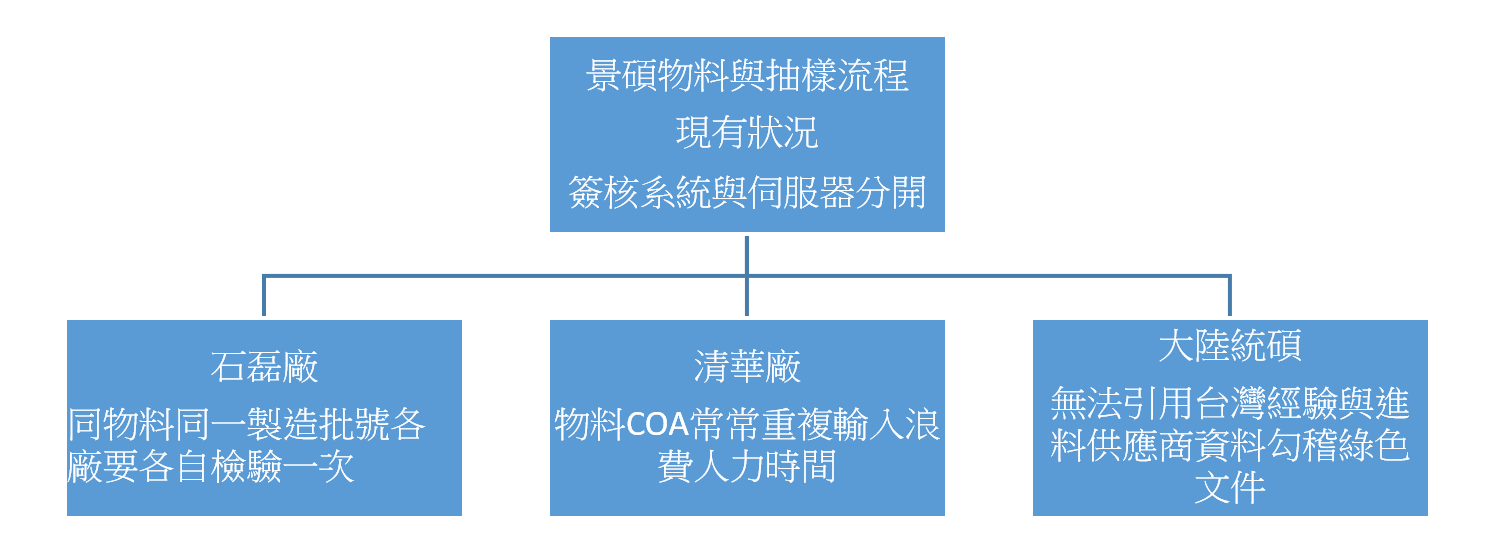
At Kinsus, the incoming material system and sampling plan, the GP system, and others were each developed separately. This time, in response to plant expansion and the migration of IT data to the cloud plus information consolidation, after evaluation it was decided to entrust the SQM + GP portion to MiDFUN for development and go-live.
The purpose of this project was to integrate the systems described above, allowing users to share a common database by moving the systems to the cloud, and enabling data to be interlinked and automatically reconciled with one another. For the same manufacturing lot, once one plant passes, the others pass automatically; the sampling process is automated and can automatically remind users when GP documents are about to expire and similar functions. This lays the foundation for incoming-material automation across Kinsus’s plants, and also allows future data such as raw-material product traceability and raw-material risk-lot analysis to be analyzed effectively.
By building MiDFUN’s SQM system, master data is interfaced with the ERP, suppliers can upload COAs, and through a well-designed sampling plan the inspection content and decisions are automatically brought in.
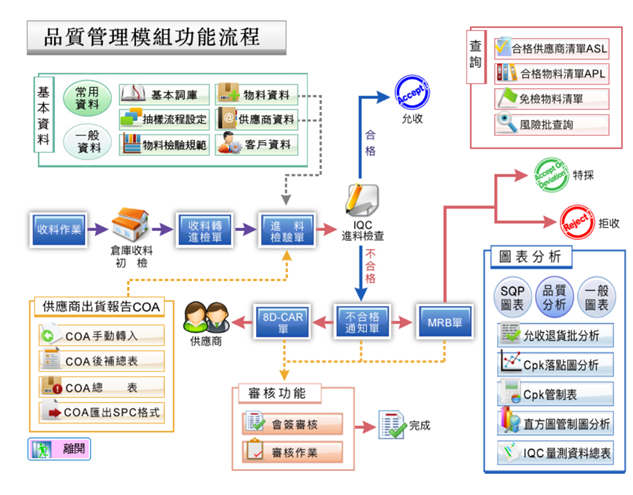
Explanation of the benefits of the current new system (after integration)
Improve the efficiency of the incoming-material quality control mechanism
Standardized OOS/OOC + checklist control records
Subsequent traceability of anomaly tickets, with 8D and MRB control records that can be reconciled against ERP payment audits
Content:
- The new SQM is interfaced and combined with the existing ERP master data, so data does not need to be created repeatedly.
- Improve the situation where standards differed across plants and processes were inconsistent, leaving suppliers at a loss.
- Under the dispersion and reorganization of the supply chain, the master-lot sampling process for each plant’s suppliers can be automated and does not need to be re-inspected; risk lots are automatically alerted, and for overdue GPD documents the system also automatically notifies the IQC personnel at each plant.
Goals:
- Allow different plants to apply the same standards for the same raw materials and suppliers, interlinked through the cloud.
- Automate the sampling process, so that the same manufacturing lot sent to different plants does not need to be inspected repeatedly.
- Automate the anomaly control mechanism, so that IQC anomalies are automatically sent to suppliers and anomaly tickets are opened automatically; supplier 8D responses are controlled without omission, and there is no longer any need to track and handle them manually as before.
| Item | Original in-plant situation | Benefits after system deployment and consulting |
| Kinsus SQM original data entry | Each plant entered its own data; could not be controlled after supply-chain reorganization | Architecture moved to the cloud, with no omissions through a central mechanism. |
| Sampling process | No sampling process, only a sampling plan table (static) | A sampling process is established against the sampling plan, and the system automatically displays the sampling quantity for this time without manual judgment. |
| ERP system integration | Each plant did its own thing | A cloud system, but controlled by plant; master data is consistent yet managed in a distributed manner. |
| Anomaly mechanism | Only a simple out-of-spec event triggered an anomaly to send an ALARM MAIL to the person in chargeThe person in charge then entered it into the ERP | An SQM mechanism interfacing with the ERP and the sampling process is established, so the system can directly link with the ERP for the anomaly mechanism according to the configured conditions. |
| Future expansion | None | In 2024, MiDFUN’s SA (Supplier Audit system) will be deployed for further automation. |
Deploying this SQM system saves at least NT$3.6 million in salary costs per year and reduces defect and management costs by at least NT$5.6 million. At the same time, the dispersion and localization of supply chains is the current trend; only by managing them effectively to reduce costs and increase efficiency in a systematic way can a company stay competitive amid a volatile situation. A cloud database architecture makes it feasible for multiple plants to share a common database, but different plants produce different products with different specifications for the same material, and the same material part number from suppliers of different grades has different inspection standards. GP composition tables and the composition of supplied materials—where composition documents (composition quantities paired with the BOM table) must also be provided when products of different lot numbers are shipped to the EU—are all opportunities and challenges for this system. Incoming-material product traceability and documents related to ESG carbon inventory are even more our next important task!
Through continuous technological innovation and process optimization, Kinsus has successfully built a digitalized and intelligent supply chain management system. In the future, MiDFUN will continue to deepen its work in the semiconductor industry and actively promote industrial upgrading, making a greater contribution to the global electronics industry.
Learn more about the SQM Supplier Quality Management System: https://www.midfun.com.tw/product/sqm/