


From attending the AI professional vendor exchange seminar held by the software association to taking part this year in the various seminars and industry matchmaking events of the Smart Factory and Smart Manufacturing groups, the discussion turned to how the Ministry of Digital Affairs has consolidated the various dedicated subsidies that previously came from the Ministry of Economic Affairs’ Industrial Development Bureau and the Ministry of Science and Technology, allowing factories that adopt and deploy applications from AI vendors to apply for subsidies through a single unified window. In addition, starting in 2023 more subsidies will be provided to vendors registered for AI capability, giving an even greater advantage when applying AI tools to improve factory competitiveness. Building on the various programs of the past few years, Taiwan already has many vendors with relevant systems, equipment, and success stories ready to go, and I believe Taiwan’s smart factory environment is gradually maturing.
The government began investing in AI for smart factories several years ago, and in recent years the relevant vendors and applications have become increasingly mature, as can be seen from this year’s various achievement presentations and matchmaking events held by the software association and the Industrial Development Bureau. (For details, please refer to the software association website and the website of the Ministry of Economic Affairs’ Industrial Development Bureau.)
I myself participate in the smart factory promotion group, responsible for the quality capability portion, where the front-end intelligent generation of machine data is the foundational work. The situation in which old machines could not output data and new machines output data in mutually incompatible formats has already improved significantly. At the same time, the vendors that develop and install the relevant SENSORs (temperature, pressure, flow, electrical properties, etc.) have also sprung up and grown like bamboo shoots after rain. What is delightful is that they formed an alliance so that the standardization of smart factories can be established more quickly and effectively, thereby laying a good foundation for the generation & integration of smart factory machine data. In addition, turning data into information flows and management charts has also matured rapidly, and the intelligent calibration of process parameter data from machines together with the quality results and production efficiency from measurement machines, leading further to mastering the techniques of precise and flexible production for high-mix, low-volume manufacturing, will provide a further scientific foundation for the ideal of AIP & AIQ.
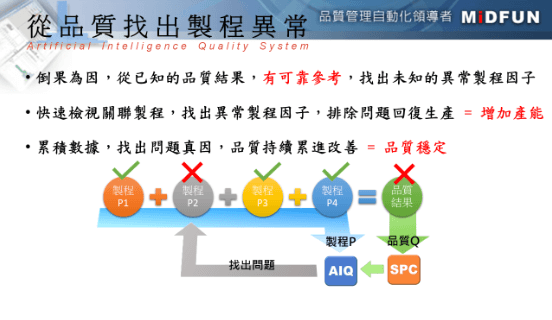
[On-the-ground Application of the Smart Factory_AIQ]
By grasping the changes in process parameters, you can understand the actual condition of the process machines; by grasping the quality measurement data, you can know the difference between the workpiece and the target after the manufacturing process. If you can grasp the changes in both P & Q at the same time, then when a problem arises with Q you can promptly identify the abnormal P that caused it and adjust it immediately, keeping the loss to a minimum, and you may even adjust P before Q exceeds its specification so that defects do not occur at all, reaching the highest realm of the superior physician who treats illness before it manifests.
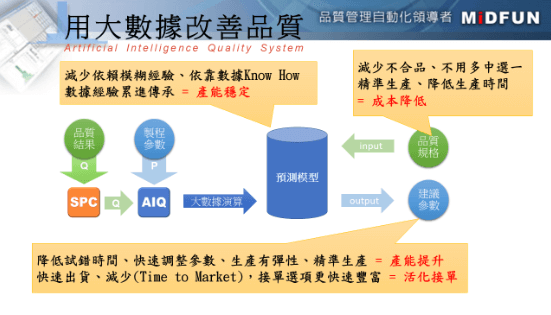
Looking at it from another angle, once you grasp both P & Q you can analyze the various relationships between P & Q according to your needs, for instance adjusting the combinations of data for Pn (a combination of multiple process parameters) and Qn (multiple control items) to achieve the goal of optimized management. For example, suppose a customer requires the target for a certain control item, originally 100-120, to be narrowed to 105-115; then you can determine which parameters on which machines should be adjusted, and from what value to what value, in order to reach the target at the lowest cost.
In the past, when this information was not grasped, it took a very long time to do trial and error, but under low-volume production the run may already be over by the time you finish testing, not to mention how much cost it would take! If you now have it in hand, not only can you adjust quickly and effectively and produce flexibly while achieving the lowest-cost optimal solution, but you can also use scientific programs to attain the essence of modern production: rapid replication, transfer, optimization, and so on.
Finally, I wish Taiwan’s competitiveness ever greater. Seize the opportunity, break through, and scale new heights once again!
Copyright © 2023 MiDFUN Co., Ltd. Some rights reserved
Author: Pei-Chi Chiu. First published: 2023-02-13. Type: Quality Management Column
This work is released under the Creative Commons Attribution-NonCommercial-NoDerivatives 4.0 International License (CC BY-NC-ND 4.0). You are welcome to share it freely, provided that you attribute the original author, include the original link, make no commercial use, and do not modify the content.
Suggested citation format: Pei-Chi Chiu (2023). “AIQ Smart Quality: From Quality Management to Smart Manufacturing.” MiDFUN Quality Management Column.
Reprint authorization and content inquiries: midfun@midfun.com.tw