


最後更新:2026.06.22
Since 1997, Nanomate Technology Co., Ltd. has been dedicated to developing, manufacturing, and selling advanced nanoscale chemical products, processes, and services such as chemical vapor deposition (CVD) materials and nano organic ceramic coatings.
Chemical vapor deposition (CVD) materials mainly provide high-purity materials for semiconductor processes and can be applied in thin-film deposition processes. As one of the few local Taiwanese companies able to supply advanced semiconductor process materials, its customer base covers Taiwan’s major semiconductor manufacturers.
The Nanomate series is a nano organic ceramic coating developed exclusively by Nanomate. The high anti-rust fastener sealant can be applied to the sealing or coating of fasteners; with a coating of only 2-3 um, it delivers high salt-spray performance of 1000 hours against red rust. The nano ceramic metal coating can have pigments and other additives mixed in to enhance the color and performance of metal surfaces, such as hardness, wear resistance, and anti-fingerprint properties, thereby increasing the added value of the product. It does not contain any heavy metal substances. As a green and environmentally friendly product, it complies with EU RoHS/WEEE/ELV/REACH regulations.
Building on its existing core technologies, Nanomate’s material development focus also extends to green energy industries such as solar power. It hopes to develop more environmentally friendly and high-quality materials.
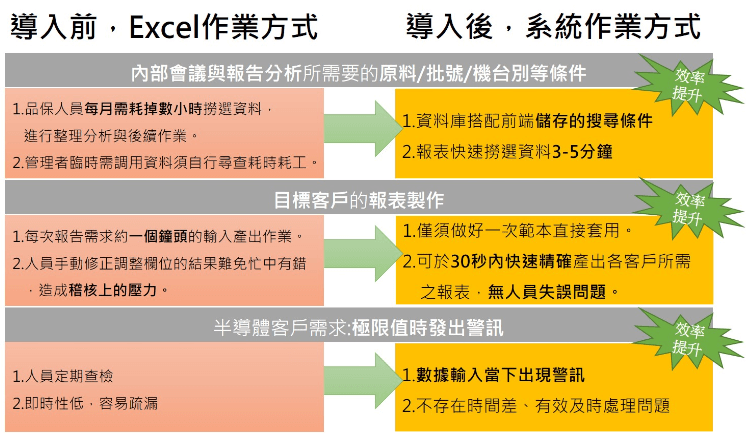
Before adopting MiDFUN SPC, using Excel could achieve part of the goal, but the operation time was lengthy. After implementing MiDFUN, the preliminary results were as follows:
1. Rapid data consolidation:
With complex conditions such as raw material, lot number, and machine, QA personnel previously had to spend several hours each month organizing data, and when managers needed to pull data on short notice they also had to search it out themselves, which was time-consuming and labor-intensive. After systematic improvement, with a database paired with search conditions stored on the front end, all kinds of reports can extract data in just a few minutes.
2. Rapid creation of customer reports:
Previously, each report took close to an hour to enter and produce, and with personnel manually correcting and adjusting fields, errors were inevitable amid the busyness, creating pressure during audits. After optimizing the workflow, it is now only necessary to set up a template once and apply it directly, accurately producing the reports required by each customer within 30 seconds.
3. Systematic operation to avoid errors:
For the formatting of statistical-data charts, it was previously only possible to provide personnel training and to check the customer-required format repeatedly when generating charts, which still easily led to mistakes or problems with items being added or removed. After systematization, chart formats are set uniformly for personnel and controlled by permissions, while the charting team additionally uses a dedicated charting configuration file to export the required chart content.
4. Real Time alerts:
Some semiconductor customers’ audit data require an alert to be triggered when a limit value occurs. Changing from the previous situation where personnel could only check periodically, after the improvement a packaged function triggers an alert directly at the moment data is entered, to remind the user.
Looking ahead, Nanomate Technology and MiDFUN, besides jointly advancing in quality management, also plan to add special control rules required by major semiconductor manufacturers (such as the Worse Chart and other specific requirements), and are evaluating systematizing the in-plant PFMEA as well, in the hope of making a further contribution to the systematization of the chemical industry in the future!