


2026.07.08 | Closed-Loop Quality Improvement Series
How to Put Factory AI into Practice: From a Governed Knowledge Base to Private LLM Integration
Author: Cheng Chi-tang | MiDFUN · Compiled by: MiDFUN Editorial Team
This article is based on Cheng Chi-tang’s presentation on closed-loop quality improvement. It will be updated if the speaker provides further clarification.
One-sentence definition
Factory AI implementation brings together a clearly defined quality problem, traceable data, a governed knowledge base, P&Q analysis, and human review. AI supports quality decisions rather than acting as an unvalidated autonomous decision-maker.
This article answers
Where factory AI should begin, what a governed knowledge base can do, and which governance boundaries matter when integrating a customer-owned LLM or private AI platform.
Who should read it
Quality leaders, IT leaders, smart-manufacturing leaders, and teams evaluating factory AI, private cloud, or an internal knowledge base.
Conclusion first
The right sequence is governed data and standard processes first, then the model. Without governance, AI merely produces more answers that cannot be verified.
In this article
AI is a major smart-factory topic, but quality management cannot begin by asking only which model to use. If data sources are uncontrolled, standards lack versioning, and quality-issue workflows have no accountable owner, even fast AI answers cannot enter a verifiable quality process.
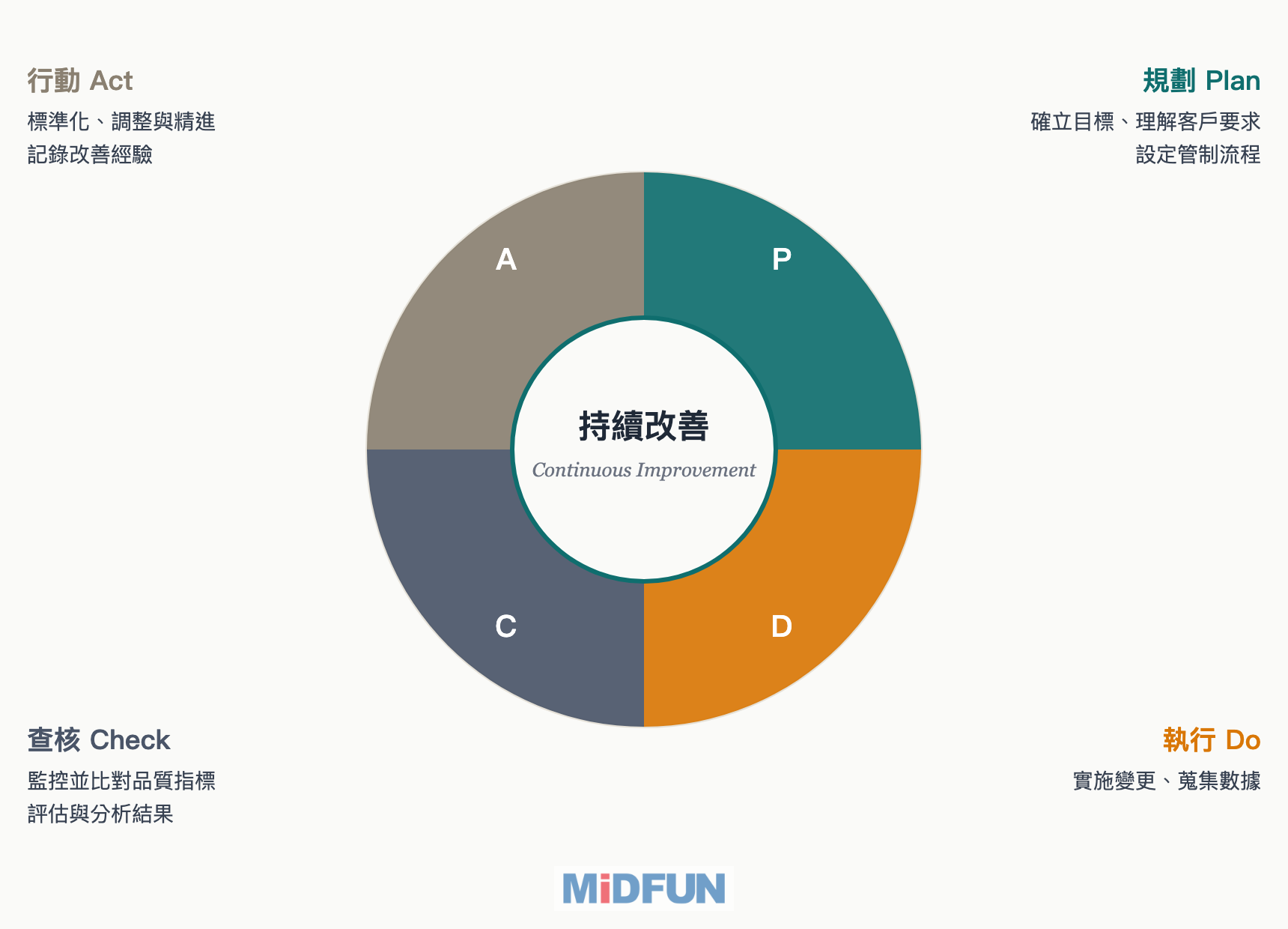
Cheng Chi-tang’s proposed direction places AI within a closed-loop quality-improvement process: define the scope, organize data and analyses, build P&Q analysis or tune the model, validate the result, write successful methods back into SOPs, and only then extend to governed knowledge and a customer’s own LLM or private AI platform.
Why can’t factory AI start with the model?
The model is only a tool; problem definition is the starting point. Choose a concrete use case, such as shortening root-cause analysis of SPC signals, assisting supplier 8D review, retrieving quality standards and statistical parameters, or helping operators find the relevant SOP. The more specific the problem, the easier it is to bound the data and verify the output.
Speaker’s viewpoint in brief
Before AI can deliver results, governed data, standard processes, and a traceable knowledge base must already exist. Without them, AI easily becomes an attractive demo rather than a quality-improvement tool.
A practical roadmap for quality AI
| Stage | Key work | Validation question |
|---|---|---|
| Scope definition | Define the quality or process problem AI must solve | Is the problem specific and testable? |
| Data collection | Inventory quality outcomes, process parameters, quality-issue records, and controlled documents | Do records include lot, time, part number, and access control? |
| Analysis and modeling | Build P&Q analysis, tune models, or create knowledge-retrieval applications | Can output be traced to its source and rationale? |
| Outcome validation | Confirm whether analysis is faster, judgment improves, or recurring quality issues decline | Are human review and accountability defined? |
| SOP integration | Write successful methods back into standard processes and the knowledge base | Has a reusable process been created? |
Governed knowledge and AI-assisted retrieval
Quality management relies on governed knowledge: statistical parameters, control-chart interpretation, normal and non-normal distributions, PQL/DL requirements, customer-specific requirements, IATF clauses, internal SOPs, historical corrective actions, and FMEA knowledge. When these are scattered across folders, new engineers and operators struggle to find the correct version quickly.
AI-assisted retrieval should help people find controlled information faster, not replace controlled documents. Ideally, every answer identifies the source, version, cited passage, and scope so engineers can return to the authoritative record before making a decision.
Key takeaway
In a governed knowledge base, the key is not response speed but whether every answer can be traced to its source, version, access rights, and review process.
Integrating a customer’s own LLM or private AI platform
Subject to the customer’s security policy, quality-system data can integrate with the customer’s own large language model (LLM) or private AI platform. This does not mean sending data to a public model. It means supporting retrieval, summarization, preliminary quality-issue tracing, or operator guidance within a controlled deployment with access management, retained logs, and traceable citations.
Future AR wearables such as smart glasses could assist operators during inspection, equipment-status checks, SPC data entry, or preliminary quality-issue tracing. Such applications must remain decision support and should not be presented as AI performing engineering judgment autonomously.
Governance priorities for quality AI
- Keep data and citations traceable so AI does not rely on obsolete or uncontrolled documents.
- Apply role-based access because suppliers, operators, engineers, and managers require different data scopes.
- Trace AI output back to source documents, system records, or analytical results.
- Treat AI output as decision support; formal decisions still require review and accountability.
- Write proven practices back into SOPs and the knowledge base to create a closed-loop quality-improvement process.
Factory AI FAQ
What is the first step in factory AI implementation?
Do not begin by choosing a model. Define a concrete problem and data scope, such as shortening root-cause analysis of SPC signals, improving supplier 8D reports, or helping engineers retrieve quality standards faster.
Can quality data integrate with a customer’s own LLM?
Yes, but data access, confidentiality, deployment, log retention, and citation traceability must be defined. For manufacturers, a customer-owned LLM, private cloud, or on-premises deployment is generally the more controllable direction.
Bring AI into a verifiable quality process
MiDFUN combines AIQ, a governed quality knowledge base, and quality-management systems to help manufacturers advance from data inventory and P&Q analysis to private AI-assisted applications.