

最後更新:2026.06.22
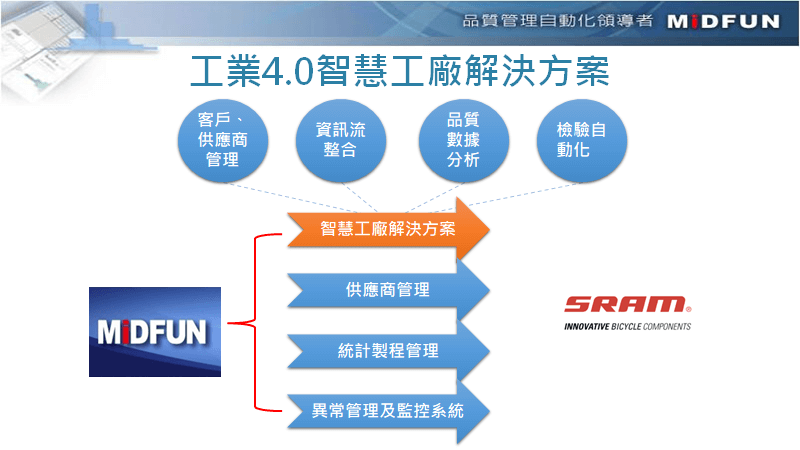
Taiwan’s bicycle industry has gradually shifted from being a means of transport to a tool for leisure and sport, and within it SRAM stands out as a premium player in Taiwanese manufacturing. To expand cooperation opportunities for the domestic processing industry, SRAM’s Taiwan plant entered into a dedicated quality management cooperation project with MiDFUN. Beyond working to reduce the cost of quality variation on its own, SRAM also coaches its suppliers in quality improvement activities, with the aim of uniting SRAM and its supply-chain partners into one body that delivers even greater strength. During this period, the plant adopted the MiDFUN SPC statistical process management system to build the quality management system for its Taiwan plant, carrying out IQC, IPQC, FQC, and OQC quality control across the entire plant, as well as the SQM supply chain quality management system to establish a supply chain JIT mechanism between the central plant and its subcontracting plants.

SRAM Corporation, headquartered in Chicago, USA, comprises not only the SRAM parent company but also three additional brands it has acquired, each responsible for a different category of components. The group is divided into four major brands: SRAM, ROCK SHOX, AVID, and TRUVATIV. Its Shengang plant in Taiwan employs more than 800 people, and its annual revenue has grown from NT$1 billion to NT$10 billion over six years. Since the plant introduced the MiDFUN SPC system in 2008, the close cooperation between the two sides has resolved various challenges encountered during implementation, thoroughly putting the Cpk control plan into practice, and the plant has become a destination for A-Team bicycle industry visits in Taiwan. The success of implementing the SPC system also gave SRAM greater confidence in MiDFUN’s professionalism and service in quality management. As a result, at the end of 2009 SRAM again partnered with MiDFUN on the SQM supplier quality management system, putting forward a comprehensive quality improvement coaching plan for its more than 160 suppliers (currently ongoing).
- Primary plan: gain visibility into supplier shipment quality and IQC quality status, and reduce the manpower spent on organizing IQC data.
- Advanced goal: help suppliers improve their process capability, putting into practice the move from Q (grasping quality inspection) to P (Process capability improvement).
- Future performance: in addition to avoiding the loss of IQC inspection manpower and the troubles caused by poor incoming quality, this project will enable suppliers, through professional coaching, to build a quality production management system at the lowest cost, achieving a win-win outcome.
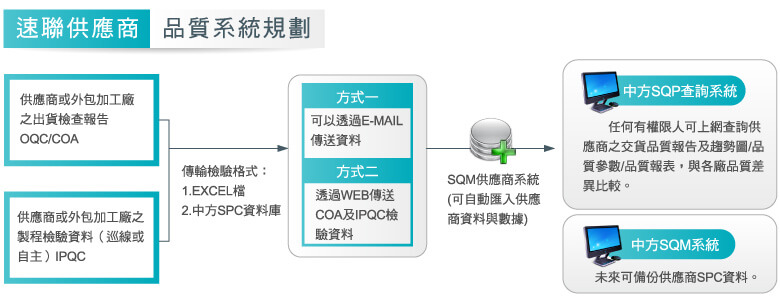
SRAM hopes to lower the cost of incoming material inspection by improving supplier quality, and to convert the saved labor and resource costs into the driving force for boosting production capacity, winning more and better customer orders for Taiwan’s bicycle industry and thereby creating more revenue and a brighter future for the entire Taiwanese bicycle industry supply chain. After half a year of discussion and research, MiDFUN and SRAM jointly built the SQM system and the Web-SQP platform, allowing different suppliers to upload COAs to SRAM’s SPC system at any time through the convenience of the internet, and using SQP as the medium for zero-distance communication between suppliers and the plant. The SQM system is then used to handle customer complaints, conduct quality assessments, and track inspections for suppliers, giving SRAM more convenient tools for quality management. Through the exchange of practical experience during the cooperation, SRAM and the MiDFUN development team learned and grew from one another. Upholding the principle of local production and shared quality prosperity, SRAM drew on the successful experience of its SPC cooperation with MiDFUN to extensively promote the concept of systematized SPC to its various suppliers.
The hope is that, through such efforts, the quality of the various suppliers can be effectively improved, allowing the bicycle industry to take root more deeply and broadly in Taiwan, and bringing the advanced quality-first concept from SRAM into Taiwan’s traditional industries. This helps suppliers stand without fear against the threat of developing countries grabbing orders at low cost, and in turn increases the added value and uniqueness of their own products, which is fully aligned with MiDFUN’s goal of being rooted in Taiwan and remaining wholeheartedly dedicated to developing quality management system services.