

最後更新:2026.06.22
Lite-On Semiconductor Corporation was founded in 1990, with its headquarters located in the Neihu District of Taipei City and five business and production sites established in Keelung, Hsinchu, and the Wuxi and Shanghai areas of mainland China. Lite-On Semiconductor designs, develops, packages, tests, and produces a wide range of green energy-saving semiconductor components used for power supplies and system power management, mainly applied in communications, information, and consumer electronics products. Since 2011, Lite-On has officially become the world’s largest supplier of AC-to-DC bridge rectifiers. With Industry 4.0 as its goal, it leverages computerization, digitization, and automation to build a more effective smart factory, which includes product failure analysis, manufacturing quality improvement and experience management, corrective and preventive action, data collection, and supply chain quality management, and builds “superior industrial capability” with the support of a robust environmental foundation.

Requirements for the quality management system
●Material Quality Management – A complete material management mechanism that covers supplier management, IQC inspection, and abnormality handling after materials go online, with all records being indexable and preventing problems from recurring.
●SPC (Statistical Process Control) – SPC functionality can be implemented in the system for key quality (CTQ) and key process (CTP) stations, with execution data automatically collected at each station and the system automatically performing control or early warning according to inspection specifications.
●Auto Hold – When a process inspection abnormality occurs, the abnormal lot number at that station is held to prevent defective products from continuing to flow downstream.
●E-Quality Report – The system generates all plant-wide quality management reports, with the reports automatically tabulating monthly/weekly/daily quality trends and allowing the required information and chart analysis to be expanded, such as by line, model, defect phenomenon, and so on.
●MSA (Measurement System Analysis) – A plant-wide MSA plan is in place, and measurement system analysis is performed on measurement equipment and personnel.
●Calibration – A plant-wide periodic calibration plan for instruments and equipment is in place, along with corresponding calibration mechanisms and control principles.
●CAR – Corresponding CAR for materials, processes, and customer complaints is used for closed-loop improvement measures (Close Loop Corrective Action).
Complete quality management system architecture
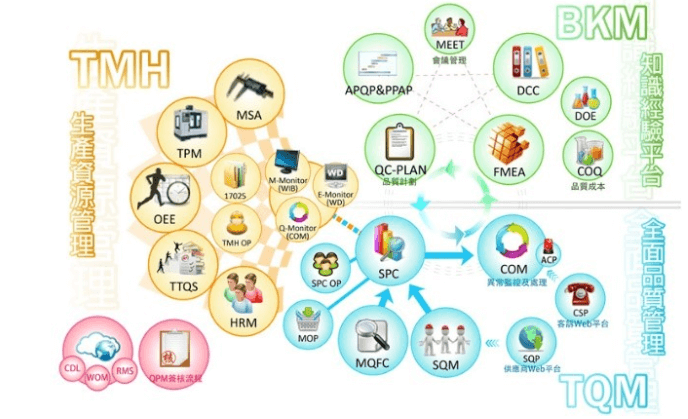
After several rounds of evaluating the major products on the market, Lite-On ultimately chose the MiDFUN QRP solution, as shown in the figure below
●Starting from the instrument management perspective, calibration scheduling is systematized with advance notification, and overdue alarms are implemented to ensure the reliability of the measurement system
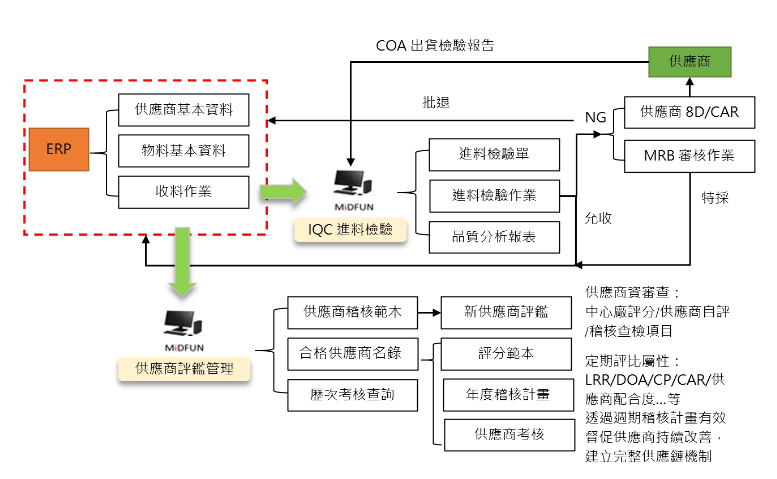
●The system manages each receiving document for IQC incoming inspection, ensuring incoming material quality before it is put into production on the line, reducing defects arising from raw materials
●Key quality elements (CTQ) and key process elements (CTP) are established at each station, providing timely feedback on current quality results through inspection data collection
●When an abnormality occurs, an abnormality document is generated in a timely manner, and through the CAR document interface the steps of abnormality description, cause analysis, corrective action, and case closure quickly resolve the problem
MES integration technology and experience
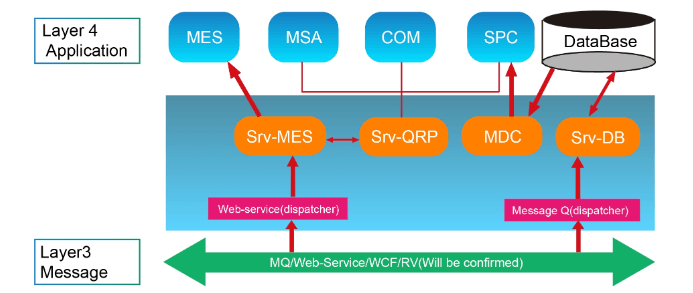
Lite-On has implemented its MES system for many years and strictly enforces control of the production process. When implementing the QRP system, information such as stations, manufacturing lot numbers, and production machines must be consistent with the MES system. The two parties planned two system integration cases as follows:
[Case One] Inspection data for each station is already collected automatically through the MES system, but the same data must also be analyzed through the SPC system, so how can rework between the two systems be avoided!? Early in the planning, both parties listed this as a must-solve item, establishing an intermediary layer between the two systems. After the MES side filters the data that needs to be analyzed, it is transferred into the SPC system for analysis through an intermediary program, which neither requires changing the operating methods of on-site units nor fails to meet quality assurance data analysis needs.
[Case Two] When an SPC inspection abnormality occurs, the abnormal lot must be able to be detained to prevent the defective lot from continuing into production. The two systems are integrated through Web service technology, so when an SPC inspection abnormality (OOS/OOC) occurs, the manufacturing lot information is immediately passed to the MES for detention. In addition, to strictly prevent possible defective products, the MES returns the information of the three preceding and three following lots so that quality assurance can quickly trace and inspect these manufacturing lots. This mechanism replaces manual after-the-fact searching – prevention is better than cure.
On-site consultant guidance in Taiwan and mainland China
Given the situation of multiple plants across both Taiwan and mainland China, to avoid the time-consuming process of gradually rolling out plant by plant, both parties established a QMS project team. With the strong support of unit managers, in addition to Taiwan consultants providing the main training, MiDFUN consultants at each plant were stationed on-site for guidance, ensuring that every plant could keep up with the project schedule, shortening the go-live timeline, and successfully going live in the most efficient way.
Supplier quality management reengineering
Reasons for implementing the system
Incoming inspection is the first link in quality management, and it is also a crucial one; controlling the quality of raw materials can also improve product yield and production stability. The total number of suppliers and raw materials that an enterprise manages is enormous: the same supplier may provide multiple raw materials, and conversely, the same raw material may come from multiple suppliers, and each raw material has its own inspection plan. Facing such a complex problem requires a dedicated system to manage it. To strengthen supplier and incoming inspection management, Lite-On Semiconductor had its information department compile the expected goals of each plant in advance:
■When the data entered on an inspection sheet exceeds specifications, the system can automatically detain the defective lot
■Electronic inspection specifications
■Electronic inspection sheets
■Risk lot warnings
■Automatic upload of measurement equipment test data
■Linking raw material abnormalities to SCAR
■Traceability of abnormal raw material lots
Electronic incoming inspection sheets
In the past, after IQC received notification of receipt from the warehouse, it would then proceed according to the paper inspection specifications looked up by raw material. After implementing SQM, the supplier and raw material inspection specifications – such as sampling rules, acceptance standards, measurement specification limits, count-value defect items, check lists, and so on – were all made electronic. The receiving sheet can be transferred directly to the incoming inspection sheet through the system interface, and when IQC opens the SQM system, it can see at a glance the documents that need to be inspected that day. During inspection, it will automatically remind about materials not received for a long time, materials received for the first time, material expiration dates, and so on, helping personnel grasp possible risk lots for stricter inspection. Documents marked with the status of pending inspection, under inspection, re-inspection, or completed allow the manufacturing department and warehouse unit to grasp progress, greatly improving the efficiency and accuracy of the past email notifications.
Manufacturing lot inspection and traceability
In response to the strict quality requirements and traceability needs of automotive electronics products, Lite-On Semiconductor requires suppliers to provide manufacturing lot information for lot-by-lot inspection. SQM provides a function to split receiving sheets into manufacturing lots, which can process and record complete inspection information in the system. If an abnormal lot appears, it immediately notifies the supplier by email and opens a SCAR linked to the incoming inspection sheet, so the supplier has a clear grasp of the processing progress of the abnormal lot.
Automated CMM connection
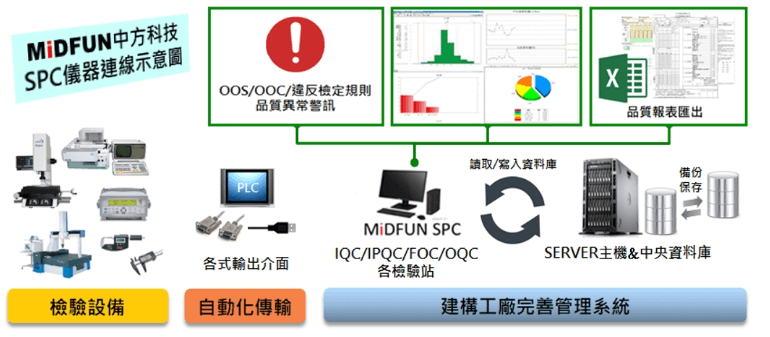
The lead frame is one of the raw materials with the most dimensions and data to inspect, so whether the system can connect with the CMM (coordinate measuring machine) is crucial. In the past, it took manpower and time to transcribe each entry one by one and judge the results, but after implementing the system, one only needs to open the inspection sheet and select the CMM output result, and hundreds of data entries can be imported and automatically judged as OK/NG, greatly speeding up inspection.
Quality report summary
Lite-On Semiconductor periodically inspects supplier delivery quality, analyzing it from the different angles of supplier, material category, and part number. The system can of course automatically generate reports summarizing information such as the number of receiving lots, receiving quantity, sampling quantity, number of defective lots, defect rate, and so on for each supplier, which also serves as a basis for supplier audits and ratings.