

最後更新:2026.06.22
New Plant – Digitally Linking Process Parameters (P) with Quality Inspection Results (Q)
When Q goes abnormal, instantly pinpoint the problematic process station
Adjust the P parameters to effectively achieve the “P&Q” linkage, stopping defective products from continuing to be produced
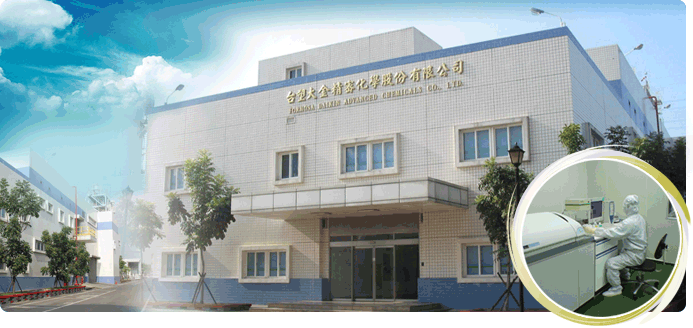
Formosa Daikin Advanced Chemicals Co., Ltd. was established in December 1999 and began full mass production in March 2002. Combining Formosa Plastics’ many years of management experience in the fluorochemical industry with the advanced precision technology of Japan’s Daikin Industries, it produces wet etchants for semiconductors. At present, Taiwan has consistently relied on imports, and as a high-purity chemical product, its quality requirements are extremely stringent. The company places even greater emphasis on the relationship between product quality control and the production process. Therefore, in addition to deploying MiDFUN’s semiconductor-dedicated SPC and MSA systems for quality control, instrument calibration management, and equipment maintenance, it additionally rolled out AIQ (the Intelligent Quality System) to gain comprehensive control over the on-site collection, monitoring, analysis, and traceability of process parameters.
Formosa Daikin built a specialty-chemicals plant, aiming to secure orders from the local “sacred mountain that protects the nation” (the semiconductor industry). Its existing plastics-and-chemicals process system was outdated and could not pass supplier audits. The company heard from its customers that Chang Chun Petrochemical, China Chemical, Tama Chemicals (Tokuyama Corporation in Japan), and Kanto-PPC had all adopted the MiDFUN system.
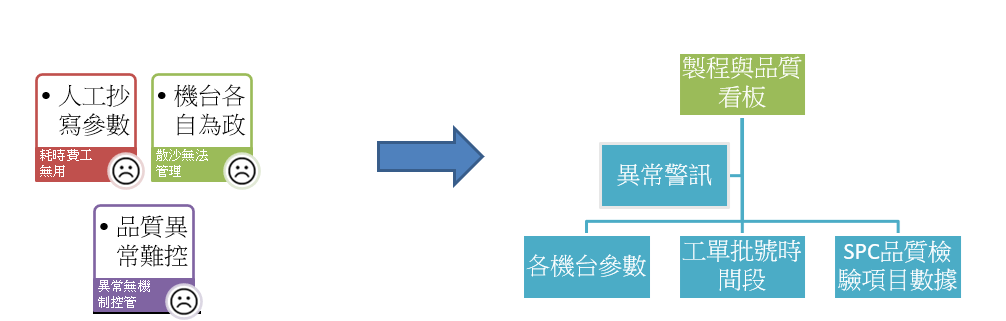
1. On-site work orders and real-time machine parameter data collection – currently, machine data is transcribed manually, and at best only one inspection round can be completed every 10 minutes, which is far too slow. Supervisors’ reports can only be analyzed after the fact. When abnormalities occur, they cannot be handled effectively, and quality cannot be controlled.
2. On-site managers complain that production part numbers are configured with programs and parameters on each process machine. When a product goes out of specification, only the single machine has the OOS reading and cannot warn the others in advance (the other machines have no screens). Setting each one individually is also time-consuming and requires a lot of manpower for rework, with no benefit.
3. The inability to display process changes in real time – this is the main reason for failing audit requirements.
4. Process-curve control – specialty-chemical products vary their process parameters over time. Temperature, flow rate, and pressure are all related to product quality, and the customer requires these to be controlled. The customer also requires a production-history report. Beyond outgoing quality inspection, control over the process-history parameter-variation curve is also a customer requirement, yet the existing manual system has no way to do this.
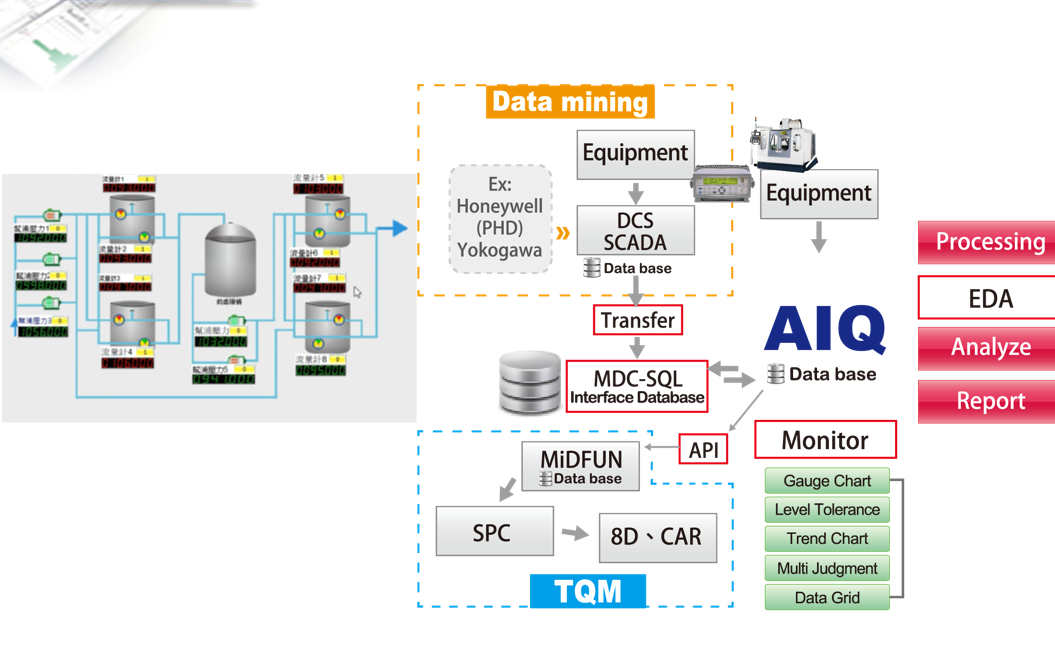
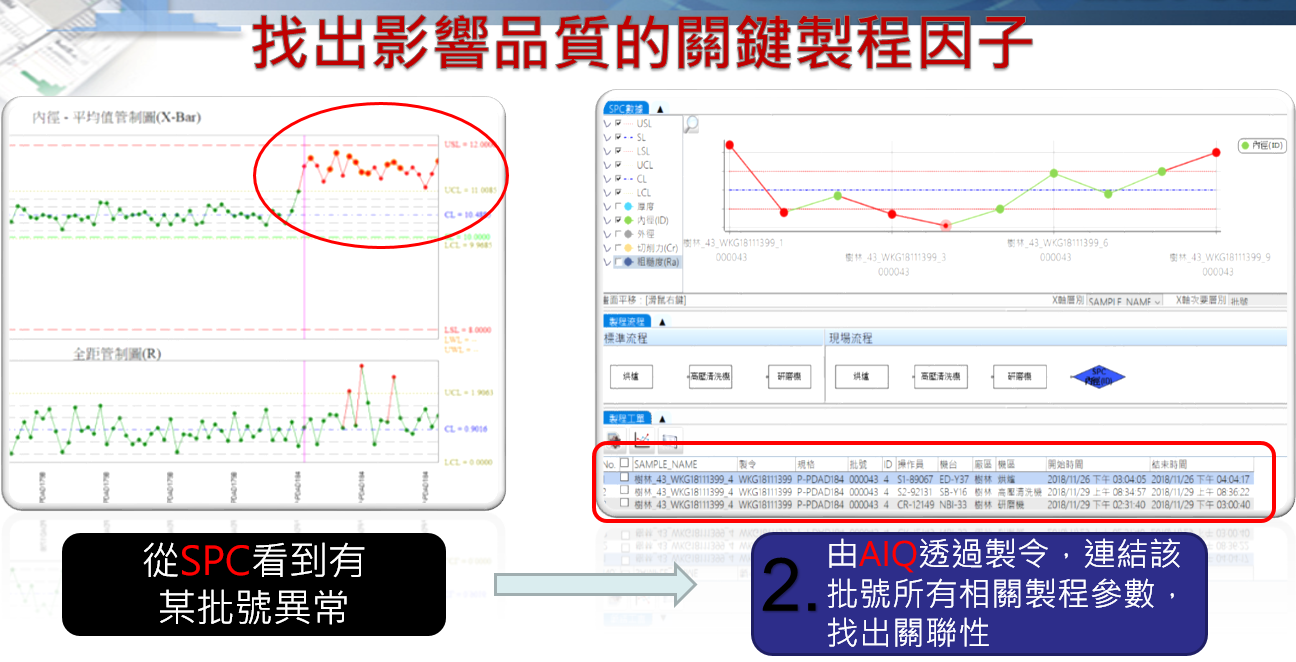
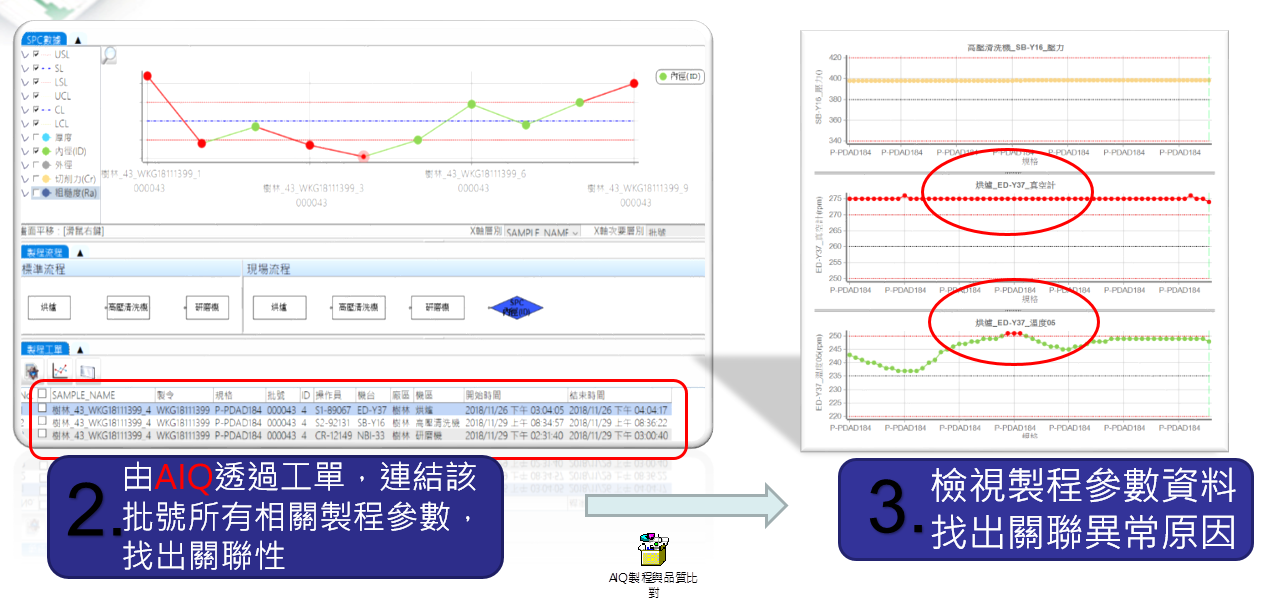
To meet Formosa Daikin’s needs, MiDFUN brought the on-site machine process parameters into the MiDFUN AIQ and SPC analysis to assess quality in real time, controlling the variation of key parameters (P) at each station’s machines and combining this with the MiDFUN SPC system (Q). Initially, at the Dafa plant, the two sides first discussed the key process parameters. Subsequently, the data was connected to the MiDFUN AIQ system, and after the MiDFUN SPC system automatically analyzed the inspection-station data, the Q abnormalities and the P process parameters were combined through work-order + lot-number + station information, allowing on-site engineering staff to identify the patterns and data of key parameter changes at the time of an abnormality and providing supervisors with scientific data to improve process capability.
Implementation approach:
- Integrate with Formosa Daikin’s database, start data collection, and import the process-parameter variation values into the AIQ database.
- For each production machine, production part number, and work order, provide upper and lower parameter limits and control them in real time, issuing an ALARM MAIL when limits are exceeded.
- By integrating the SPC database with the AIQ system database, users can review in real time whether the quality at each station is normal, and when an abnormality occurs, real-time messages are provided to the control personnel (such as abnormal quantity, data, the abnormal work order and lot number, the time window of the part-number abnormality, suspect process machines and personnel, etc.).
- AIQ can provide downstream analysis functionality, using mathematical models to design control models for the process-characteristic curves of various machine types, effectively controlling the characteristic variation of machines across different process types.
- Provide a process-quality production history, where one can view the parameter variation of each lot of product at each process station by part number, lot number, machine type, machine number, time, etc.
- Provide an automatic QIR report function, where consolidated process and inspection results are combined with automated analysis reports and automatically sent on schedule to the relevant supervisors and customers.
Benefits:
- Input personnel no longer need to enter data manually; it is transferred directly into this system via AIQ and SPC.
- When a machine abnormality during the production of a given part number leads to a defective product, a real-time warning can be issued.
- Process changes for products across the entire plant can be controlled, so that production abnormalities can be discovered and corrected in real time.
- Managers can grasp changes in process status, finding improvement models from front-line machine changes and elevating the quality of high-end products.
- Meeting customer requirements, the company can grasp the production history and data of each lot of product across each process, allowing both sides to jointly discuss how to improve problems in advanced processes.
- Daily, weekly, and monthly quality reports are automatically compiled and sent to the relevant supervisors, who can grasp quality changes firsthand and respond to them.
- The process-parameter variation of a given product in each tank can be searched by part number and lot number and plotted into graphs, so that analysts can grasp the production-process history.
- Explain and educate the customer’s relevant personnel on the interlocking concepts and use the system to strengthen their overall awareness from process to quality. Enhancing soft power.
Architecture flow:
Traceability linkage:
Conclusion:
In 2023, MiDFUN carried out the SPC, MSA, and AIQ implementation, and after going live in 2024, the traceability of plant-wide quality and production parameters was perfectly integrated. This not only meets customer requirements but also enables more precise control and analysis of the process, allowing Formosa Daikin to run efficient processes oriented toward the Industry 4.0 big-data production model and effectively meet the requirements of semiconductor-chemical customers.