


最後更新:2026.06.22
January 29, 2026 | Author: Pei-Chi Chiu
Control Plan
IC Substrate
IATF 16949
New VDA Edition
About This Case
Nan Ya PCB Corporation (Nan Ya PCB), the world’s second-largest manufacturer by ABF substrate output value, formally adopted the MiDFUN FMEA (Failure Mode and Effects Analysis) system in 2024, successfully achieving line-by-line linkage and integration between FMEA and the Control Plan, in compliance with the new AIAG-VDA edition standard and IATF 16949 audit requirements. After one year of deployment at the Taiwan plant and the Kunshan plant, results were significant; at the end of 2025 Nan Ya PCB signed a five-year system maintenance contract with MiDFUN and launched a PLM system integration project.
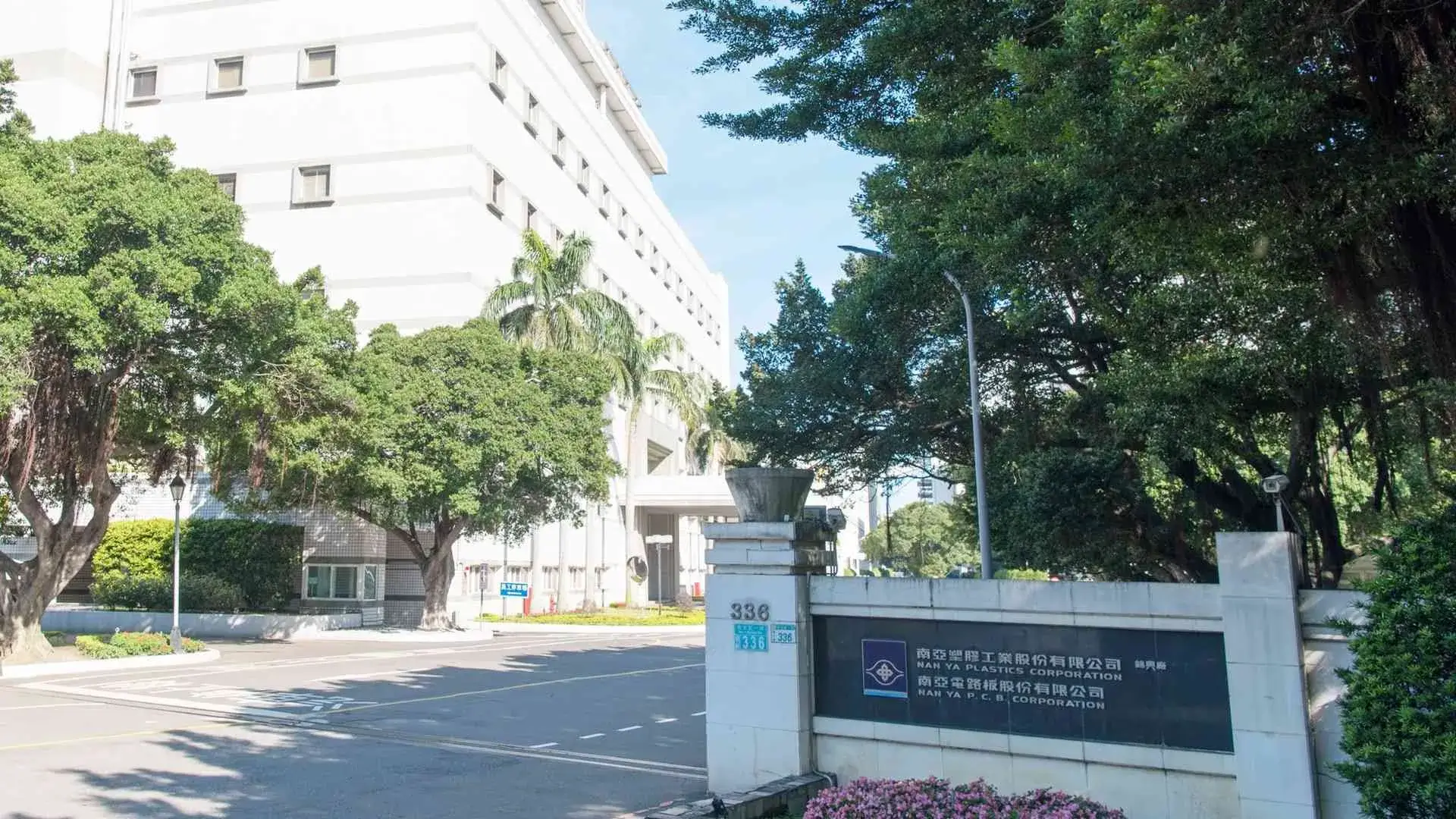
Customer Profile: Nan Ya PCB Corporation
Nan Ya PCB Corporation (hereafter Nan Ya PCB) was founded in 1997. Originally part of the Printed Circuit Board Division of Nan Ya Plastics under the Formosa Plastics Group, it has become an indispensable IC substrate manufacturer in the global chip supply chain. Nan Ya PCB focuses on the research, manufacturing, and sale of IC substrates, with technology spanning ABF substrates, PP substrates, conventional PCB, and high-density interconnect (HDI). Its products are sold primarily to overseas markets, serving leading global makers of computers, communications, networking, consumer electronics, and automotive electronics.
As the semiconductor industry moves toward high-density, multifunctional, small-form-factor chips, Nan Ya PCB continues to invest resources in strengthening its IC substrate process technology and quality management capabilities, supporting emerging technology applications such as 5G, cloud computing, big data, autonomous driving, and artificial intelligence. With deep technical strength and a global footprint, Nan Ya PCB has risen to become a world-class IC substrate supplier, holding a critical position in the global technology supply chain.
Project Background: New FMEA Format Changes and Customer Integration Requirements
Nan Ya PCB had already built its own FMEA system in-house, but faced with the new edition of the AIAG-VDA FMEA Handbook released in 2019, the format, process, and architecture all underwent major changes. According to the AIAG-VDA FMEA Handbook (2019) standard, the new FMEA edition adopts the 7-Step Approach for systematic analysis and replaces the traditional RPN scoring method with AP (Action Priority), emphasizing a prevention-oriented risk management mindset.
In addition, Nan Ya PCB’s major customers (including leading packaging and testing firms such as ASE) placed strong demands on line-by-line linkage and integration between FMEA and the Control Plan. Per IATF 16949:2016 clause 8.5.1.1, the Control Plan must remain consistent with the FMEA, and any process change requires both documents to be updated in sync. This requirement made the traditional separate-management approach unsustainable, sharply increasing the error risk and labor burden of manual maintenance.
Combined with the scheduling pressure on its IT staff, Nan Ya PCB found it difficult to complete the system revision and integration development internally within a short time, and therefore decided to evaluate external professional system suppliers.
Why Choose MiDFUN?
The Only Software System Supplier Delivering Line-by-Line FMEA+CP Linkage
After extensive market evaluation and detailed explanation from the MiDFUN team, Nan Ya PCB confirmed that MiDFUN is the only software system supplier that can truly achieve line-by-line FMEA+CP linkage. The MiDFUN FMEA software system supports the new AIAG-VDA 7-Step Approach architecture, mapping the failure modes, causes, and current controls in the FMEA directly to the control items in the Control Plan, ensuring consistency between the two documents and real-time linked updates.
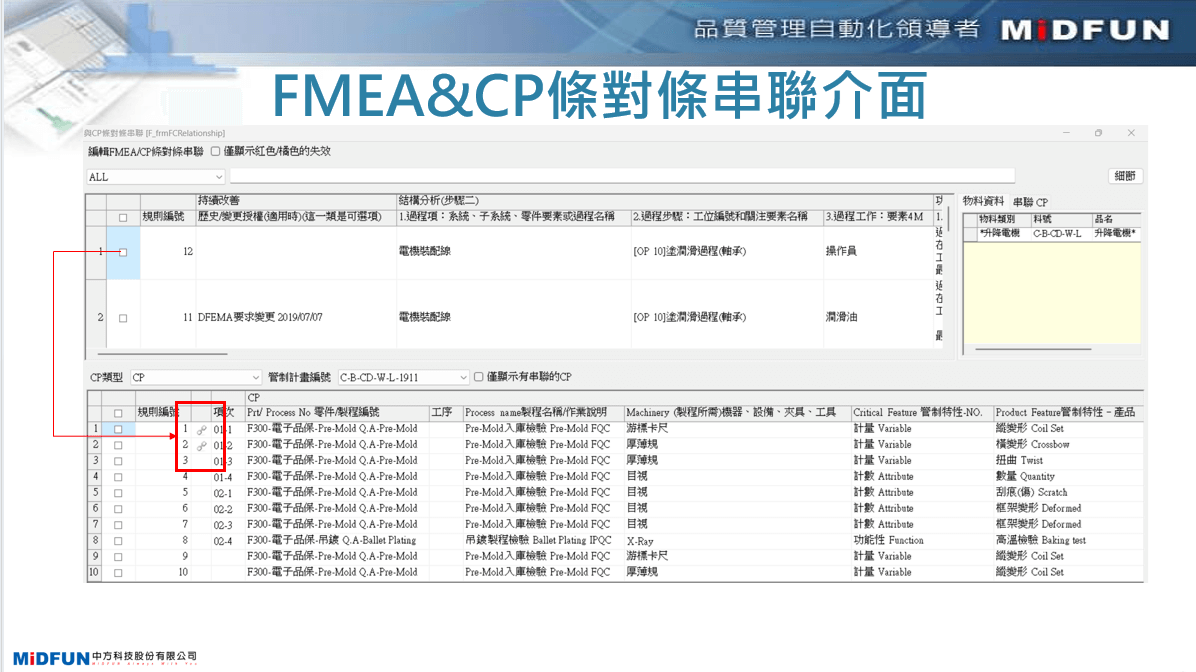
Real-Time On-Site Support Across Both Sides of the Strait
MiDFUN has four branch offices in Taiwan and service locations in Kunshan and Dongguan, China, providing real-time on-site support and professional consulting capabilities. For an enterprise like Nan Ya PCB that operates multiple plants across the strait, MiDFUN can provide a consistent deployment standard and cross-plant technical support, substantially reducing the risk of going live.
Linked Version and Master Version Management Functions
Through the MiDFUN software’s linked version and master version management functions, Nan Ya PCB can easily maintain document consistency and version control. When the master FMEA is updated, all linked versions automatically inherit the changes, avoiding the version chaos caused by each plant maintaining its own copies, while meeting the latest information security and internal control requirements.
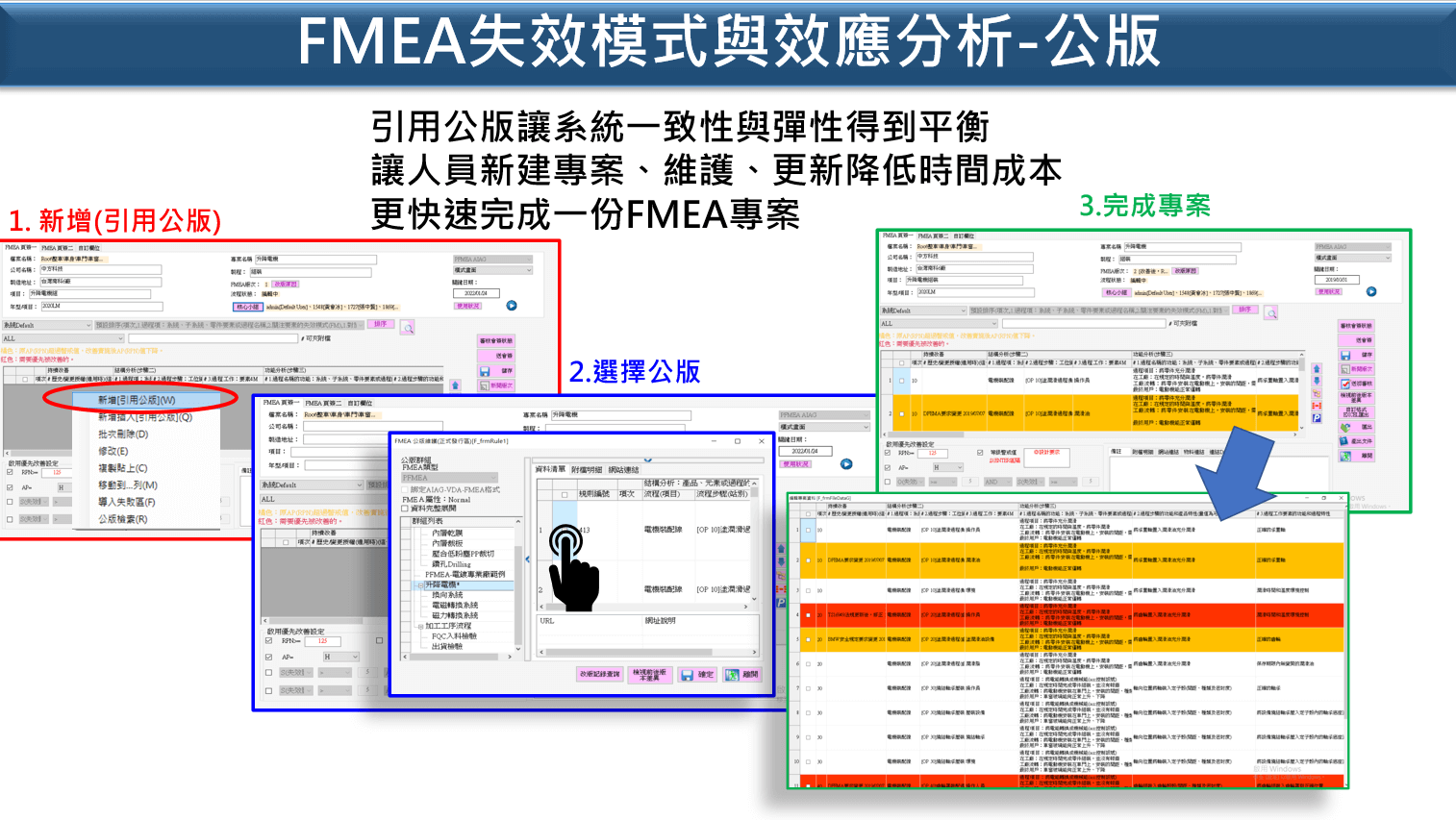
Deep Integration with Internal Enterprise Systems
The MiDFUN FMEA software system supports PLM system API connectivity and Single Sign-On login integration, and can link seamlessly with BPM approval workflows. Without changing users’ operating habits, it achieves consistent management of new-edition FMEA review and personnel permissions, lowering the resistance to adoption.
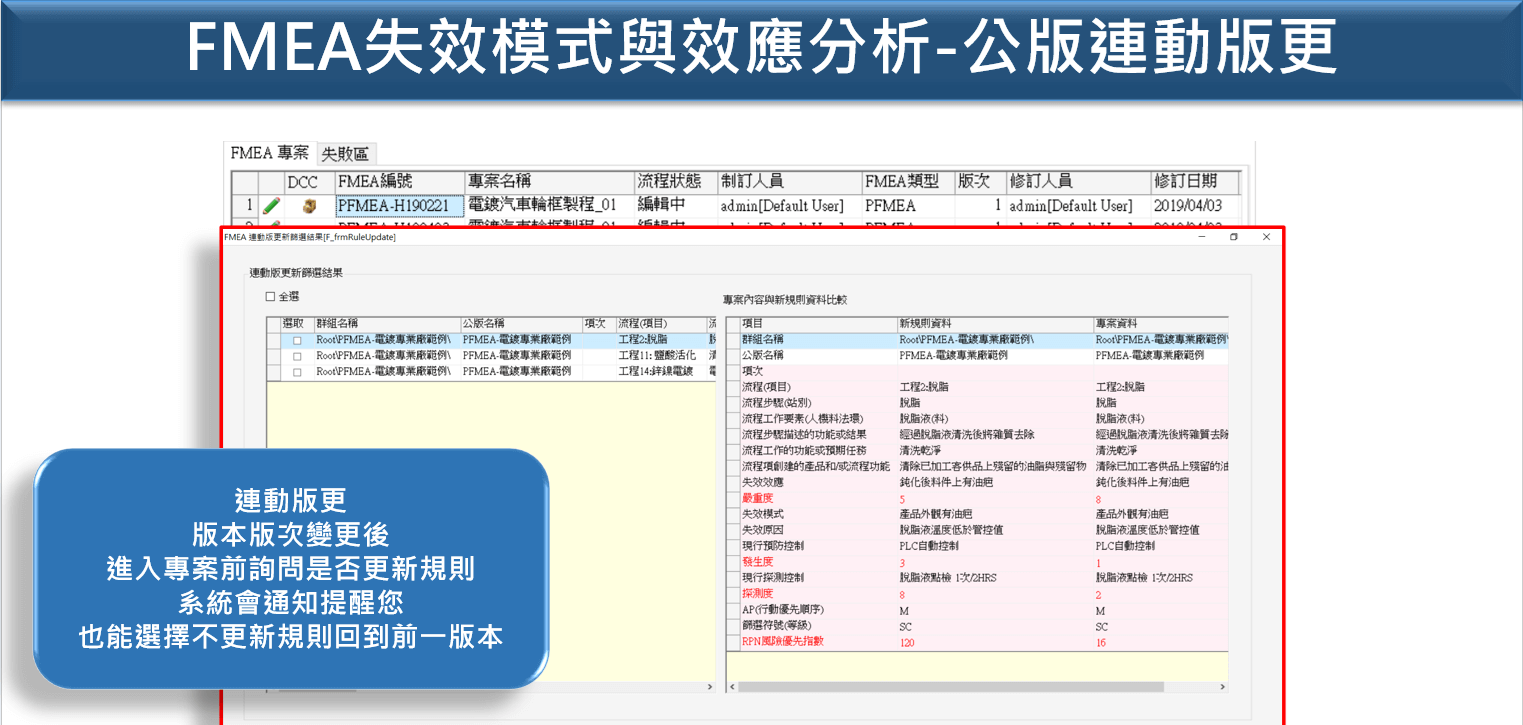
Deployment Scope and Results
| Item | Details |
|---|---|
| Deployed product | MiDFUN new-edition AIAG-VDA FMEA software system (including Control Plan integration module) |
| Deployment sites | Taiwan plant, Kunshan plant (deployed in 2024); expanding to more units and manufacturing locations in 2026 |
| Core functions | Line-by-line FMEA+CP linkage, linked version and master version management, automated confidentiality levels, version-advancement mistake-proofing mechanism |
| System integration | PLM system API connectivity, Single Sign-On login integration, BPM approval workflow linkage |
| Contract term | Five-year system maintenance contract (signed at the end of 2025) |
| Deployment results | Compliance with the new IATF 16949 regulatory requirements, fulfillment of customer FMEA+CP integration needs, reduced staff burden, automatic data updates, and cross-system linkage |
Conclusion: Deepening Collaboration to Drive a Comprehensive Upgrade in Quality Management
After one year of deployment at the Taiwan plant and the Kunshan plant, results were significant. At the end of 2025, Nan Ya PCB went further and signed a five-year system maintenance contract with MiDFUN and launched an integration project with other internal systems. In 2026, building on the existing collaboration, the two parties will expand the FMEA software’s use to more units and manufacturing locations, deepening the system’s benefits.
The MiDFUN FMEA software system supports automated confidentiality levels and a version-advancement mistake-proofing mechanism, and is deeply integrated with PLM to achieve automatic data updates and cross-system linkage, effectively reducing staff burden and driving a comprehensive upgrade in Nan Ya PCB’s quality management.
📖 Glossary: FMEA = Failure Mode and Effects Analysis | CP = Control Plan | AP = Action Priority | PLM = Product Lifecycle Management | SSO = Single Sign-On
Frequently Asked Questions
Q1: What is the FMEA (Failure Mode and Effects Analysis) system?
FMEA (Failure Mode and Effects Analysis) is a systematic risk analysis method used during the product design or process planning stage to identify possible failure modes in advance, analyze their effects and causes, and develop prevention or detection measures. Simply put, FMEA is a product’s “health checklist,” helping enterprises find potential problem areas in advance. The MiDFUN FMEA software system supports the new AIAG-VDA 7-Step Approach architecture and can link line-by-line with the Control Plan, ensuring the completeness and consistency of risk management.
Q2: Why do FMEA and the Control Plan need line-by-line linkage?
Per IATF 16949:2016 clause 8.5.1.1, the Control Plan must remain consistent with the FMEA. The risk items and control measures identified in the FMEA should map directly to the control items in the Control Plan. Line-by-line linkage ensures that when the FMEA is updated, the Control Plan updates in sync, avoiding the error risk of manual maintenance and allowing the consistency and traceability of the documents to be demonstrated quickly during audits.
Q3: Which enterprise systems can the MiDFUN FMEA software system integrate with?
The MiDFUN FMEA software system supports PLM (Product Lifecycle Management) system API connectivity, Single Sign-On login integration, and BPM approval workflow linkage. Through these integration capabilities, enterprises can achieve consistent management of FMEA review and personnel permissions without changing users’ operating habits, and attain automatic data updates and cross-system linkage.
Q4: How long does it take to deploy the MiDFUN FMEA software system?
The deployment timeline varies with enterprise size, the volume of existing documents, and system integration needs. In the Nan Ya PCB case, the Taiwan plant and the Kunshan plant completed deployment within one year and demonstrated significant results. MiDFUN has four branch offices in Taiwan and service locations in Kunshan and Dongguan, China, and can provide real-time on-site support and professional consulting services to help enterprises bring the system online smoothly.
Q5: What other quality management system products does MiDFUN offer?
MiDFUN has cultivated the manufacturing quality management field for over 30 years. In addition to the FMEA (Failure Mode and Effects Analysis) system, it also offers a complete product line including the SQM supplier quality management system, SPC statistical process control, the MSA instrument management and calibration analysis system, APQP/PPAP advanced product quality planning, the 8D customer complaint management and quality improvement system, and TPM total productive maintenance management, providing integrated quality management solutions tailored to enterprise needs.
About MiDFUN
MiDFUN was founded in 1993 and is a professional manufacturing quality management software company in Taiwan, with over 30 years of dedicated experience. The industries it serves span electronics manufacturing, machinery and equipment, automotive components, semiconductors, automotive electronics, aerospace, and more. MiDFUN has four branch offices in Taiwan and service locations in Kunshan and Dongguan, China, providing real-time on-site support and professional consulting services.
Want to learn more? Please see: FMEA Failure Mode and Effects Analysis | SQM Supplier Quality Management | SPC Statistical Process Control
Get in Touch Now
Contact MiDFUN to learn how to deploy an FMEA+CP integrated system for your enterprise.
Go to Contact Us →