


最後更新:2026.06.22
Customer Profile: Diodes Incorporated

Diodes Incorporated (Nasdaq: DIOD) is a global manufacturer and supplier of semiconductor discrete components, analog, and mixed-signal products, widely used in the consumer electronics, communications, industrial, and automotive markets. The Diodes Hsinchu branch is its six-inch wafer fabrication plant in Taiwan, offering stable process technologies such as High Voltage CMOS and Bipolar, with a monthly capacity of approximately 25,000 wafers.
* The customer information above is cited from Diodes Incorporated’s publicly disclosed corporate data (Nasdaq: DIOD) and does not involve any non-public or confidential information.
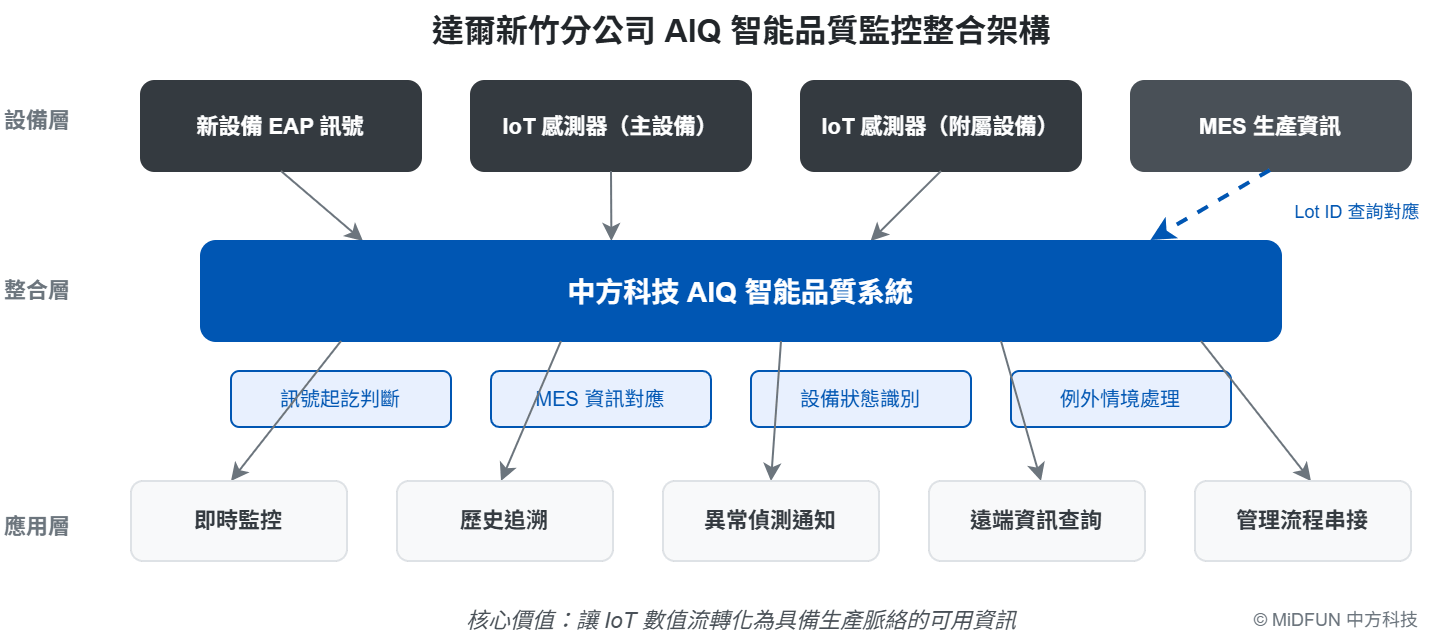
From Equipment Signals to Production-Context Integration
On the manufacturing floor, acquiring equipment data is not necessarily the hardest part. What is truly challenging is often how to give this data understandable production context so it can genuinely support monitoring, query, and management needs. For many factories, the floor may already have existing connectivity mechanisms and may have continuously accumulated large amounts of equipment signals and sensor data. But if the system architecture is outdated and hard to maintain, or if the data cannot be effectively mapped to production information, it becomes very difficult to further transform it into a stable and scalable application.
MiDFUN recently helped the Diodes Hsinchu branch advance an equipment data integration project, progressively consolidating a connectivity application that had been used for years—developed in-house and increasingly hard to maintain—into the MiDFUN AIQ Intelligent Quality System, establishing a more complete and sustainably maintainable real-time monitoring and query architecture. This project was not merely a simple data hookup, but covered new-equipment EAP signal integration, new IoT signal integration, and the mapping and combination of MES production information, further transforming previously scattered equipment values into application information usable for factory management.
Project Background: Taking Over an Existing System, Solving the Maintenance and Extension Problems of an Outdated Connectivity Architecture
The customer’s site already had a connectivity application developed in-house years ago, used to collect equipment- and process-related signals for internal use. Such systems can usually solve specific needs effectively in the early days, but as equipment is updated, management needs grow, and the original developers move on, they often gradually face several typical problems: the system structure is hard to extend, maintenance costs rise, exception handling becomes difficult, and new equipment or new data sources are hard to integrate in a consistent way.
For factories, this situation is actually quite common. A system that originally worked may not be able to continue supporting subsequent digitalization needs—especially when a factory wants to simultaneously capture more equipment data, improve real-time monitoring capability, and further connect data with MES, quality management, or exception-handling processes. Relying solely on the original legacy program is often no longer sufficient.
Therefore, one of the core tasks of this case was, without departing from the actual operating conditions on the floor, to take over the existing logic and data context and progressively integrate the previously hard-to-maintain connectivity application into the MiDFUN AIQ platform, making the data sources, monitoring screens, and foundation for subsequent applications more consistent.
Project Scope: Integrating EAP, IoT, and MES to Build a More Complete Application Data Chain
The data sources covered by this project can mainly be divided into three layers:
1. New-Equipment EAP Signal Integration
As equipment is updated, the data interfaces and formats available on the new-equipment side are progressively standardized. But how to effectively integrate this data into the existing quality monitoring and query architecture still requires planning and implementation aligned with actual application needs. MiDFUN helped the customer integrate the relevant program items and data of the new-equipment EAP into the MiDFUN AIQ system according to project requirements, so that equipment data can be uniformly managed and used on a single platform.
2. New IoT Signal Integration (Including Auxiliary Equipment)
IoT signals can usually provide real-time values, including various process or status parameters during equipment operation, which are very important for on-floor monitoring. However, IoT data is mostly just a stream of values. Without further status interpretation and mapping to production information, it can often only exist as raw data, making it hard to truly become application data that is queryable, traceable, and manageable.
3. MES Production Information Integration
In factory practice, if equipment values cannot be mapped to actual production batches, Lot information, or process context, their application value is greatly limited. Therefore, in addition to equipment signal collection, this case also required further connection with MES to supplement production information, so that equipment data is no longer just an isolated value but can establish a mapping relationship with actual production activities.
| Integration Layer | Data Source | Integration Benefit |
|---|---|---|
| EAP Equipment Signals | New-equipment program items and process data | Unified management platform, replacing the fragmented architecture |
| IoT Sensor Signals | Real-time parameters of main equipment + auxiliary equipment | Real-time monitoring, equipment status interpretation |
| MES Production Information | Production batches, Lot ID, process context | Equipment data mapped to production activities, traceable |
The Real Challenge: IoT Is Not Just Collecting Values, but Determining “Which Production Segment This Data Belongs To”
The part of such projects that demands the most technical depth and on-floor experience is often not “whether the data can be brought in,” but how to determine the start and end of equipment or process operation based on signal changes, and to map that segment of data to the correct production information.
Take IoT sensor signals as an example: what the system receives is usually continuous value changes, such as parameter fluctuations during equipment operation, status values of auxiliary equipment, and signal changes under different condition switches. These values do not, by themselves, directly tell the system: “where this production batch starts and ends,” “which Lot this segment of data corresponds to,” or “whether the current status is formal production, standby, switching, idle running, or an exception interruption.”
In this case, the MiDFUN team needed to establish reasonable determination logic based on on-floor equipment characteristics and signal patterns, identifying equipment behavior and process stages from a plain stream of values, and then—based on the determination results—request the corresponding production information (such as Lot ID) from MES, completing the integration of equipment data with production context.
The reason this is difficult is that real on-floor scenarios are not as simple as theoretical models. Different equipment, different conditions, different batches, and even different ways that auxiliary equipment operates can all cause variations in signal behavior. The system must consider not only normal production states but also various possible exception scenarios, such as transitional states, brief pauses, condition switches, non-standard operations, or signal anomalies. If the determination logic is not rigorous enough, start/end misjudgments and data mapping errors can occur, which in turn affect the credibility of subsequent monitoring and queries.
For this reason, this part of the work is not just a technical hookup—it also involves understanding on-floor process behavior, equipment logic, and management needs. The role MiDFUN played in the project was to help the customer progressively organize knowledge previously embedded in equipment experience and on-floor operations into integration logic that the system can execute, maintain, and extend.
Deployment Results: Bringing Equipment Data Truly into Monitoring, Query, and Management Processes
After integration through this project, the customer can consolidate EAP equipment data, IoT main-equipment and auxiliary-equipment signals, and MES production information into the MiDFUN AIQ platform, forming a more complete application data foundation. This integration means equipment signals are no longer just raw data scattered across the floor, but can be transformed into usable information with a temporal context, equipment status, and production mapping relationships.
At the application level, the MiDFUN AIQ system can support:
| Application Function | Description |
|---|---|
| Real-Time Monitoring | Real-time display of on-floor equipment and process conditions |
| Historical Traceability | Data queries by Lot, time, and equipment conditions |
| Anomaly Detection | Detection of abnormal conditions and real-time notification |
| Remote Visibility | View on-floor equipment information from the office |
| Process Connection | Further integration with management processes and handling mechanisms |
For users, this change is not just a more complete screen—the way information is used is upgraded as well. In the past, when only scattered values were visible, people often had to rely on the experience of floor staff to understand what the data meant. Now, through start/end determination, MES mapping, and data integration, the system can provide information content closer to the actual production context, improving the usability of monitoring and queries and giving a stronger foundation for subsequent anomaly interpretation and management applications.
MiDFUN’s Value: Not Just Connectivity, but Integrating Factory Data into Deployable Application Capabilities
What MiDFUN provided in this case is not just single-point data hookup, but an integrated capability combining the AIQ Intelligent Quality System, project-specific customization development, and IoT planning, design, and connectivity services. For factories, the truly difficult part is often not buying a new system, but how to make the new system absorb the equipment logic, exception scenarios, and cross-system needs accumulated on the floor over many years—and progressively complete deployment without disrupting actual operations.
Key Takeaway of This Case: IoT signals by themselves are only values, but what factories truly need is data with context. MiDFUN helped the customer connect equipment values, equipment status determination, and MES production information, so that data is not merely collected but can truly support monitoring, query, and subsequent management needs.
Conclusion: Taking Data from “Visible” to “Usable”
In the process of factory digitalization, many enterprises already have a certain foundation of equipment data. But if the data remains scattered, hard to maintain, or lacking production context, its value often cannot be fully realized. What MiDFUN helped the Diodes Hsinchu branch accomplish is not only the technical integration of EAP, IoT, and MES, but also the further organization of raw equipment data into application data that can support on-floor monitoring and management.
For manufacturing, truly valuable system integration is not just bringing data into a platform, but enabling data to correctly map to equipment status and production information, becoming a digital foundation that can be continuously used, maintained, and extended. This is also the direction MiDFUN continues to invest in: helping factories start from on-floor needs to build genuinely deployable intelligent quality and data integration applications.
Key Terms
Quick Glossary
Frequently Asked Questions
Q.What is the AIQ Intelligent Quality System? How is it different from a typical SPC system?
A: The MiDFUN AIQ Intelligent Quality System is a platform that integrates IoT equipment data collection, real-time monitoring, anomaly detection, and quality management. Compared with an SPC system, which mainly focuses on statistical process control, AIQ has a broader scope, covering equipment signal integration, MES production information mapping, and cross-system data consolidation. It is particularly well suited to smart factory applications that need to manage multiple data sources simultaneously.
Q.Our factory already has its own in-house equipment connectivity system. Do we still need to deploy AIQ?
A: This is precisely the starting point of this case. Many connectivity systems developed in-house in the early days often face difficult maintenance and limited extensibility as equipment is updated and personnel change. MiDFUN AIQ can take over the existing logic, integrate scattered data sources into a unified platform, improve maintainability and extensibility, and preserve the original data context.
Q.After IoT data is brought into the system, how do you know which data corresponds to which production batch?
A: This is the most technically demanding part of the case. The MiDFUN team establishes start/end determination logic based on the signal characteristics of on-floor equipment, identifying equipment behavior and process stages from the continuous IoT value stream, and then queries MES for the corresponding production information such as Lot ID, completing the automatic mapping of data to production context.
Q.After the AIQ system is deployed, can people in the office also see on-floor equipment conditions?
A: Yes. The MiDFUN AIQ system supports real-time monitoring screens. The office side can view on-floor equipment operating status, process parameters, and anomaly notifications through a web page, allowing them to grasp production conditions without going to the floor.
Q.Besides AIQ, what other quality management systems does MiDFUN offer?
A: MiDFUN has deep roots in manufacturing quality management spanning more than 30 years, with a product line covering SPC Statistical Process Control, FMEA Failure Mode Analysis, SQM Supplier Quality Management, MSA Measurement System Analysis, and TPM Total Productive Maintenance, applicable to industries such as electronics manufacturing, semiconductors, automotive components, and aerospace.
About MiDFUN
About MiDFUN
MiDFUN was founded in 1993 and has been deeply engaged in quality management software for Taiwan’s manufacturing industry for more than 30 years, providing the semiconductor, electronics manufacturing, automotive components, and other industries with
AIQ Intelligent Quality System,
SPC Statistical Process Control,
and FMEA Failure Mode Analysis system solutions, helping enterprises achieve digital transformation in quality management.