



The Industrial Revolution arose around the 1760s and continued into the 1830s and 1840s. It was followed by the so-called Second Industrial Revolution (1870) and the Third Industrial Revolution since the 20th century, leading to what is now called the Fourth Revolution of technological digitalization. Quality systems have likewise continued to evolve, from quality inspection, quality manufacturing, and quality management to quality design. Bringing the timeline up to 2024, from a quality perspective, how exactly will today’s technology trends help quality systems? And how should a factory’s quality managers view this, or where should they focus their applications to maximize benefit for the company?
We need to understand that technology is an evolutionary process. Even disruptive innovation must go through a process of replacement; for example, it took roughly a decade or more for digital cameras to replace film. At the AI seminar on 2023.9.25, OpenAI CEO Altman and Andrew Ng, the father of Google AI, also noted that AI currently plays only a supporting role, and that developing from supporting to replacing will still take over a decade. The impact of modern technology on manufacturing is low-volume, high-variety production, but the demands on quality only grow higher. Regarding the application of quality regulations, manufacturing, and quality systems over the next few years, the author offers some views on future quality technology applications for the reference of manufacturing quality managers. First, taking the IATF16949 core tools that represent mature industry as the foundational framework, the explanation is as follows:
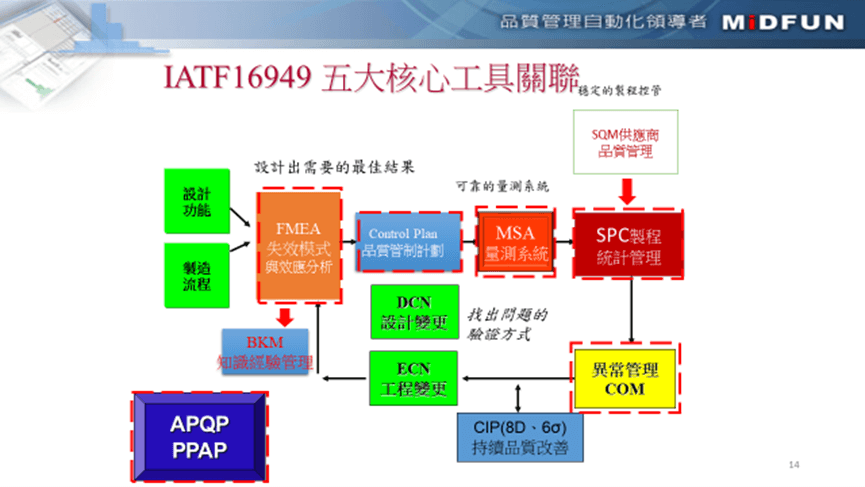
The APQP and PPAP in the lower-left corner usually address the project workflow and document provision for new product development, so we will skip them here. The focus is on the items to be done in the factory’s daily routine. The core part is further divided into four major categories; adding AIQ and MSA, it can be counted as six core categories. 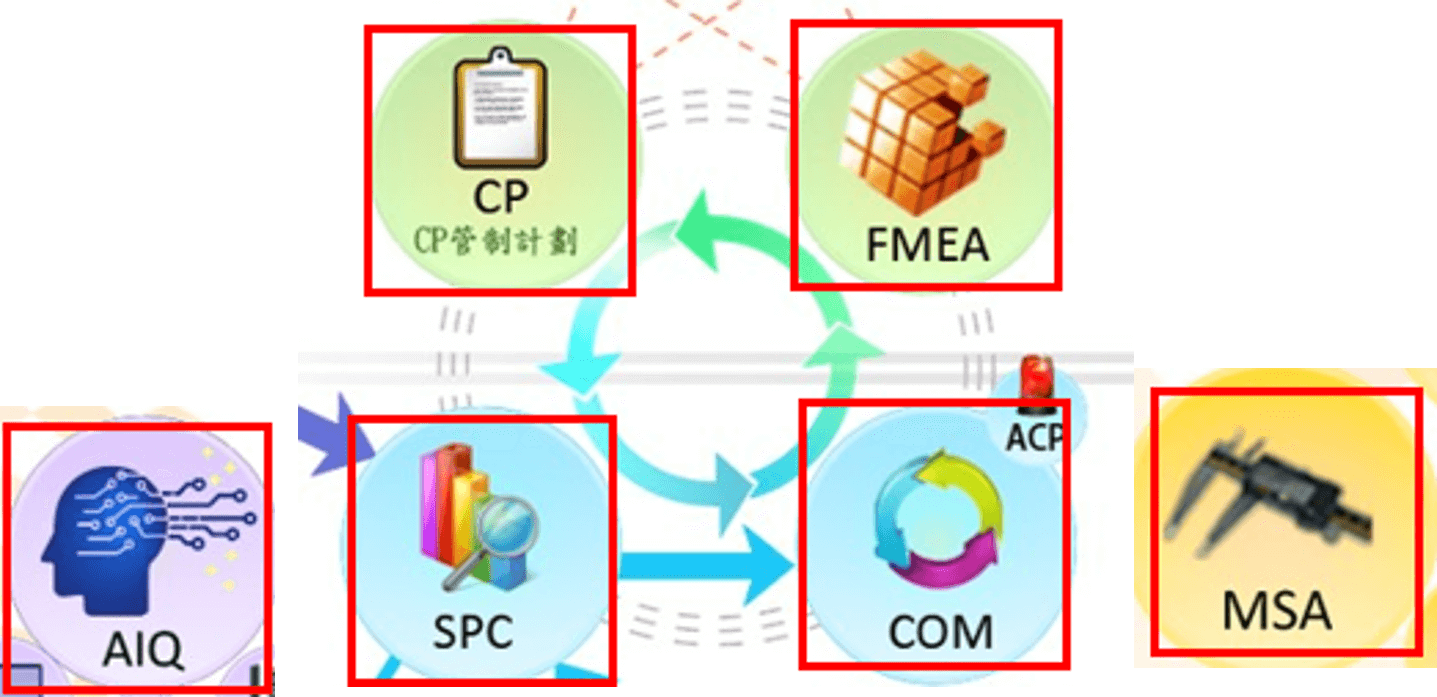
The establishment of a quality system follows the logic below
- Draft the factory quality plan: This is usually prepared together with the production plan. For product development, the tools used are APQP, PPAP, and QFD (Quality Function Deployment).
- Identify priority quality concerns AP: These are the key focus items within the factory quality plan. For establishing the factory quality control plan, the tools used are FMEA and CP. From the control plan, one can define the factory inspection stations and control items, variable/attribute data SPC, and the measurement system MSA.
- Quality anomaly data collection, root-cause statistics, corrective measures, and recurrence prevention: From incoming inspection IQC, in-process inspection SPC, the anomaly platform COM, anomaly correction 8D/CAR, to systematic recurrence prevention ACP, with DCN and ECN updating the FMEA version, effectively optimizing process quality and even design quality.
From inspection to manufacturing to design quality, among the 5M1E factors that affect quality, the factor with the greatest weight and that can be controlled by the factory is the process parameters commonly known as machine P&Q (Quality). This part, which involves big data and causal relationships, can leverage AI technology to identify the largest influencing factors and control them so that quality remains stable, costs are reduced, efficiency is increased, and competitiveness is enhanced.
So what areas can be worked on in 2024, and which of today’s technologies offer the most cost-appropriate solutions?
- Automated SPC data collection___The topic of full inspection has already been discussed in a previous article. In terms of collection cost and computational effectiveness, sampling inspection is still the most cost-effective. However, with the cost of automated measurement instruments now falling and personnel costs rising sharply, building an automated data collection system that integrates MES and ERP data, especially real-time automated monitoring of critical-station data, becomes even more important under low-volume, high-variety production.
- SPC-MSA-COM systematization__Automatically combine the OOS/OOC anomaly data from SPC with in-factory anomalies, incoming-material anomalies, customer-complaint anomalies, and so on, so that under a stable measurement system, anomaly issues are quickly resolved systematically.
- Automated reporting__Automatically produce inspection reports for managers, automatically send shipping inspection COA reports to customers, automatically send anomaly reports to managers, and automatically send real-time anomaly data to process personnel to stop defects from continuing to occur.
- AIQ __ For certain specific critical processes where the P&Q pattern has already been identified, build an AIQ system to control from P so that the occurrence rate of defects Q is reduced, systematically and effectively improving yield.
In other respects, although there are some prominent technology trends as follows, the one that can mainly be matched with our quality system in 2024 is the first item, the application of artificial intelligence in quality systems. For quality, the application of generative AI may be less than that of decision-based AI, because a factory cannot accept feeding the same data into AI and getting a different answer each of five times. Items 2 to 4, although important, may still be relatively difficult to apply to quality systems in 2024 as their cost-effectiveness declines. The cybersecurity part is an issue for the entire information system; for the quality system, it is sufficient to comply with TLS1.2 or related standards, such as passing a vulnerability scan.
- Artificial intelligence (AI) will become ubiquitous
- The leap in quantum computing
- Expansion of the metaverse
- A surge in sustainable technology solutions
- Cybersecurity becomes even more important
In summary, for the managers of quality systems, on the eve of 2024’s arrival, I hope this article helps everyone grasp the key points so that, with the least time and resources, they can secure the greatest benefit in quality for the company.
Copyright © 2023 MiDFUN Co., Ltd. Some rights reserved
Author: Pei-Chi Chiu. First published: 2023-10-23. Type: Quality Management Column
Original link: https://www.midfun.com.tw/qc/2024%e5%b9%b4%e7%9a%84%e5%93%81%e8%b3%aa%e7%a7%91%e6%8a%80%e8%b6%a8%e5%8b%a2/
This work is released under the Creative Commons Attribution-NonCommercial-NoDerivatives 4.0 International License (CC BY-NC-ND 4.0). You are welcome to share it freely, provided that you credit the original author, include the original link, do not use it commercially, and do not modify the content.
Suggested citation format: Pei-Chi Chiu (2023). “Quality Technology Trends for 2024”. MiDFUN Quality Management Column.
For reprint authorization and content inquiries: midfun@midfun.com.tw