


Advanced Product Quality Planning –
(Advanced Product Quality Planning), abbreviated as APQP
Advanced Product Quality Planning
Advanced Product Quality Planning (abbreviated as APQP), also known as advance product quality planning and control plan
What is Advanced Product Quality Planning
Advanced Product Quality Planning (abbreviated as APQP) is a structured method used to determine and establish the steps required to ensure that a product satisfies the customer.
The goal of Advanced Product Quality Planning is to facilitate communication with everyone involved, so as to ensure that the required steps are completed on time.
Effective product quality planning depends on the commitment of top management (PM) to the purpose of striving to satisfy the customer.
The purpose of APQP
(1) develop a product quality plan to develop products that meet customer requirements and achieve customer satisfaction;
(2) complete critical tasks on time;
(3) obtain production part approval on schedule;
(4) continuously meet customer specifications;
(5) continuous improvement.
The benefits of APQP
(1) directs resources toward customer satisfaction;
(2) promotes early identification of all changes;
(3) avoids late changes;
(4) delivers a quality product on time at the lowest cost.
The five phases of APQP
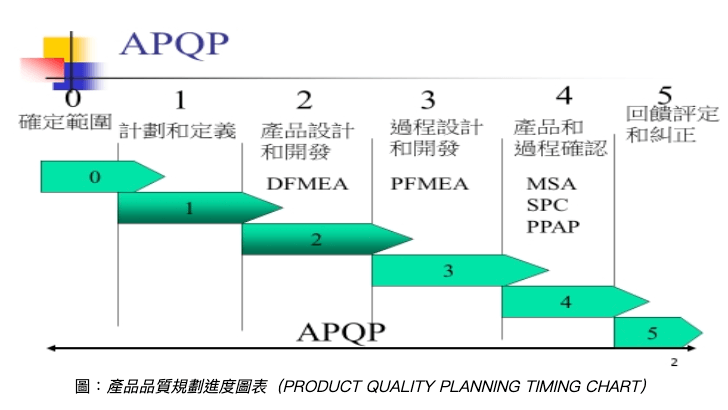
1. Plan and Define
The task of this phase: how to determine customer needs and expectations in order to plan and define a quality program; everything done must keep the customer foremost in mind; confirm that the customer needs and expectations are perfectly clear.
2. Product Design and Development
The tasks and key points of this phase: discuss the elements of the quality planning process that develop the design features into their final form; the team should consider all design elements, even if the design is owned by the customer or shared by both parties; the steps include prototype build to verify that the product or service satisfies the task of the “voice of service”; a feasible design should be able to meet production volume and schedule requirements, and must also consider quality, reliability, investment cost, weight, unit cost, and timing targets; although the feasibility study and the control plan are based mainly on engineering drawings and specification requirements, the analytical tools described in this chapter can also capture valuable information to further determine and prioritize the characteristics that may require special product and process controls; ensure a comprehensive and rigorous review of the technical requirements and related technical data; conduct an initial feasibility analysis to review the potential problems that may occur in the manufacturing process.
3. Process Design and Development
The tasks and key points of this phase: ensure the development of an effective manufacturing system, ensuring that customer needs, requirements, and expectations are met; discuss the main features of the manufacturing system established to obtain a quality product and the control plan related to it.
4. Product and Process Validation
The tasks and key points of this phase: discuss the main points of verifying the manufacturing process through a trial production run evaluation. It should be verified whether the control plan and the process flow chart are followed, and whether the product meets customer requirements. Attention should also be paid to the study and resolution of relevant issues before formal production.
5. Feedback, Assessment, and Corrective Action
The tasks and key points of this phase: quality planning does not stop just because the process validation is in place. During the manufacturing phase, all special and common causes of variation will be revealed, and we can evaluate the output, which is also the time to evaluate the effectiveness of the quality planning work. In this phase, the production control plan is the basis for evaluating products and services. Both variable and attribute data should be assessed. Take the appropriate actions described in the SPC manual.
The foundations of APQP
1. Organize the Team
The cross-functional team is the organization for implementing APQP;
The team must be empowered (with defined responsibilities);
Team members may include representatives from: engineering, manufacturing, material control, purchasing, quality, sales, field service, suppliers, and customers.
2. Define the Scope
Specific content includes:
Determine the team leader;
Determine the responsibilities of each member;
Determine internal and external customers;
Determine customer requirements;
Understand customer requirements and expectations;
Assess the feasibility of the proposed design, performance requirements, and manufacturing process;
Determine cost, schedule, and constraints;
Determine the help needed from the customer;
Determine the documented process and format.
3. Team-to-Team Communication
Between the customer, the internal organization, and the subteams within the team;
The means of communication can be holding regular meetings, with the degree of communication based on need.
4. Training
The success of APQP depends on an effective training plan;
The content of the training: understanding customer needs and the development skills to fully satisfy customer needs and expectations, for example: customer requirements and expectations, Working as a team, development techniques, APQP, FMEA, PPAP, etc.
5. Customer and Organization Involvement
The primary customer may initiate the quality planning process with an organization;
The organization has the obligation to establish a cross-functional team to manage APQP;
The organization must require the same of its suppliers.
6. Concurrent Engineering
Concurrent engineering: the cross-functional team carries out product development and process development concurrently, so as to ensure manufacturability and assemblability, shorten the development cycle, and reduce development cost;
Concurrent techniques are the process by which the cross-functional team works toward a common goal;
Replacing the previous level-by-level handoff method;
The purpose is to bring high-quality products into production as early as possible;
The team ensures that the plans and activities of other areas/teams support the common goal;
Examples of supporting techniques for concurrent engineering;
Network technology and data exchange and related technologies;
APQP software technology;
QFD;
In addition, concurrent engineering also makes extensive use of techniques such as the Taguchi method, FMEA, and SPC.
7. Control Plan
Control plan—a systematic written description of the system for controlling parts and processes. Each control plan includes three phases;
Prototype——a description of the dimensional measurements, material and performance tests that occur during the prototype build process;
Pre-launch——a description of the dimensional measurements, material and performance tests that occur in the manufacturing process after the prototype but before full production;
Production——a comprehensive description of the product/process characteristics, process controls, tests, and measurement systems that occur in the volume production process.
8. Problem Solving
The APQP process is a problem-solving process;
Problem solving can be documented using a responsibility—time matrix table;
In difficult situations, a reasoned problem-solving approach is recommended;
Various quality-control methods and corresponding analytical techniques can be used.
9. The Timing Plan for Advanced Product Quality Planning
The first task of the APQP team after completing the organization chart—develop the timing plan;
Factors to consider for the timing plan—product type, complexity, and customer expectations;
Team members should reach consensus;
The timing plan chart should list—tasks, responsibility assignments, and other relevant matters (reference: Gantt chart):
A uniform format for the planning team to track progress and set meeting dates;
Each task should have a start date and an expected completion time, with the actual situation recorded;
Focus on identifying the items requiring special attention, supporting the monitoring of progress through effective status-reporting activity.
10. The Plans Related to the Timing Plan Chart
The success of the project depends on—a timely and cost-effective manner;
The APQP schedule and the PDCA loop require the APQP team to do its utmost to prevent defects. The APQP process is a process of taking error-proofing measures and continuously reducing product risk;
Defect prevention——driven by the concurrent engineering of product design and manufacturing technology;
The planning team should be prepared to revise the product planning plan to meet customer expectations;
The responsibility of the planning team——to ensure that the schedule meets or is ahead of the customer’s schedule plan.
Gantt charts and milestone charts, etc., are the charts produced in this phase.
Copyright © 2023 MiDFUN Co., Ltd. Some rights reserved
Author: Pei-Chi Chiu. First published: 2023-02-23. Type: Quality Management Column
Original link: https://www.midfun.com.tw/qc/apqp-%e5%85%88%e6%9c%9f%e7%94%a2%e5%93%81%e5%93%81%e8%b3%aa%e8%a6%8f%e5%8a%83/
This work is released under the Creative Commons Attribution-NonCommercial-NoDerivatives 4.0 International License (CC BY-NC-ND 4.0). You are welcome to share it freely, provided that you attribute the original author, include the original link, do not use it commercially, and do not modify the content.
Suggested citation format: Pei-Chi Chiu (2023). “APQP – Advanced Product Quality Planning”. MiDFUN Quality Management Column.
Reprint authorization and content inquiries: midfun@midfun.com.tw